
Welcome to the Diocese of Southern Ohio
In 1817, the Episcopal Church was established in the Diocese of Ohio in the newly minted state of Ohio. The dramatic growth of the nation and the state, largely due to the industrial revolution, necessitated dividing the diocese. The decision was finalized at the Diocese of Ohio’s convention in 1873, and two years later, the newly formed Diocese of Southern Ohio held its first conference at Trinity Episcopal Church in Columbus. Since its inception, the Diocese of Southern Ohio and its people have brought the Christian message of love and reconciliation to a world in need. The words of Episcopalians throughout the diocese expressing these deeply held values are presented here in a people’s history of the Diocese of Southern Ohio.
150th History & Storytelling Webinar
The History and Storytelling Group for our 150th anniversary as a diocese hosted a webinar on Thursday, September 4th with a panel of diocesan leaders: the Rev. Canon Jane Gerdsen, Robin Holland, Joshua Sherwood, the Rev. Mike Smith, and the Very Rev. Owen Thompson. Bishop White opened our time together with welcome and prayer, and the Rev. Karl Stevens, chair of the History & Storytelling Group, facilitated the panel. Click here to watch the recording.
Our History
St. John’s Episcopal Church, Worthington
James Kilbourne organized the first Episcopal Church in Ohio, St. John’s Church in Worthington in 1804. This photograph of the church dates from 1888.
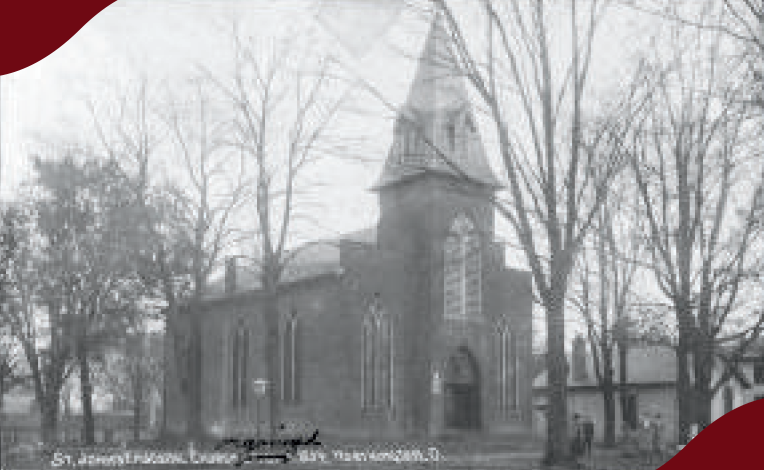
“They built this church by hand—it reminds me of kind of the folk notion of a barn raising. You know, everybody coming together, using the materials they made themselves…They made the bricks; they carved the pews by hand themselves. There are four pillars in the center of the worship space but inside the plaster, there are four black walnut trees that they cut by hand from what is now High Banks Metro Park, floated down the river to Worthington and then installed in the church….None of them could have done it themselves, but pulling together, working together as a community, they could, and they’ve given us this incredible building.”
The Reverend Gia Hayes-Martin
Rector, St. John’s Episcopal Church, Worthington
Bishop Thomas Jagger (1875-1904)
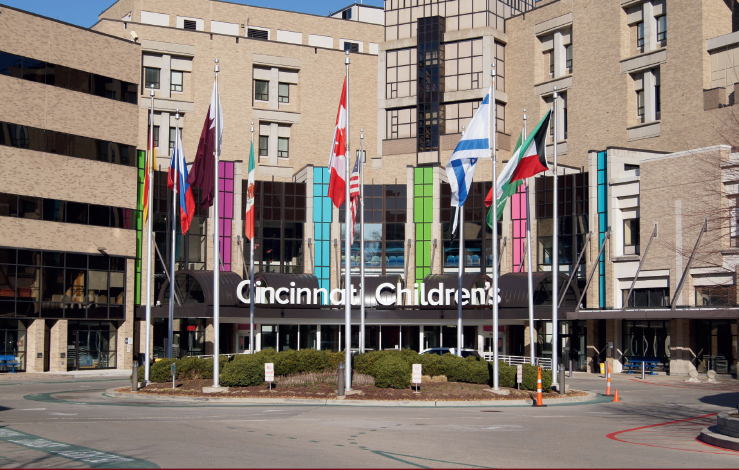
New York native, the Rt. Rev. Thomas Jaggar, served as the first bishop of the Diocese of Southern Ohio. During his tenure, parishes and missions in the diocese grew from 48 to 67. One of the most important institutions founded was Children’s Hospital in Cincinnati, now Cincinnati Children’s Hospital Medical Center — the first diocesan charitable institution, seen here.
Women and the Church
Episcopalian women have long served the needs of the church and played a powerful role in spreading the Word of God, despite limitations placed on the interpretation of that role. In the Diocese of Southern Ohio, an early recognition of the need to be more inclusive occurred under Bishop Boyd Vincent. In his 1920 address to the diocesan convention he welcomed the establishment of the House of Church Women, which met at the same time as the convention, where they shared worship but had their own agendas.
Coadjutor Bishop Theodore Reese stated that women should be “given equal rights with men on vestries and in diocesan conventions with vote and voice. The Church cannot be less just or democratic than the state,” although it was not until 1928 that the Church welcomed women as full delegates to the convention.
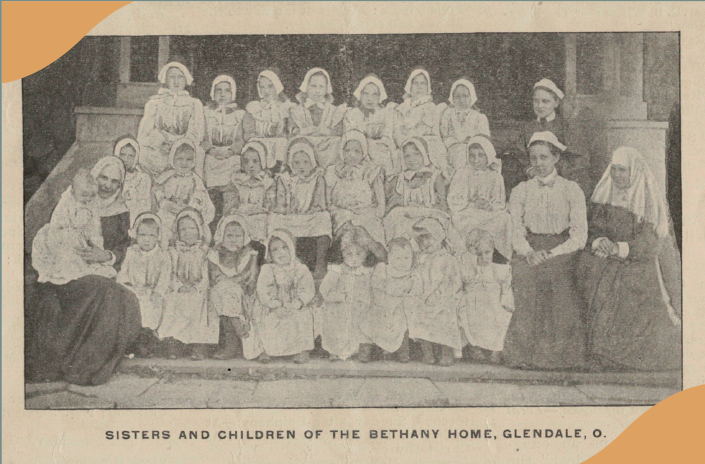
Eva Lee Mathews, the sister of Paul Mathews, rector of St. Luke’s Cincinnati, and Beatrice Henderson took orders and founded the Community of the Transfiguration in Glendale with the mission of prayer and spreading God’s love. One of their first major projects was the establishment of Bethany House, to provide for impoverished children. Over time, their ministries grew to include a school, children’s recreation center, retreat center and a food program.
The Women’s Movement in the 1960s spurred increased demands for the ordination of women in the Episcopal Church. In 1966, a resolution passed by General Convention opened the diaconate to women and stated that women currently serving as deaconesses were members of the diaconate. The 1970 and 1973 General Conventions narrowly defeated a motion opening up the priesthood to women. In defiance, three bishops ordained eleven female deacons to the priesthood—the Philadelphia 11—in 1974. Recognizing the inevitable, the 1976 General Convention followed suit, forever changing the face of the Episcopal Church.
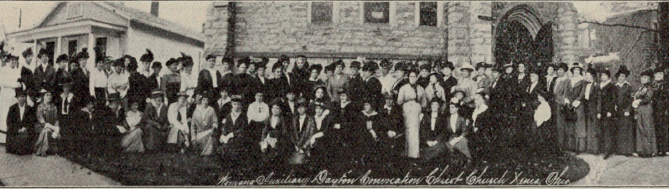
The Dayton Women’s Auxiliary met at Trinity Church in Xenia on October 22, 1914. The Church Messenger stated that a “large number” attended and “indicated an increasing interest in missionary work.”
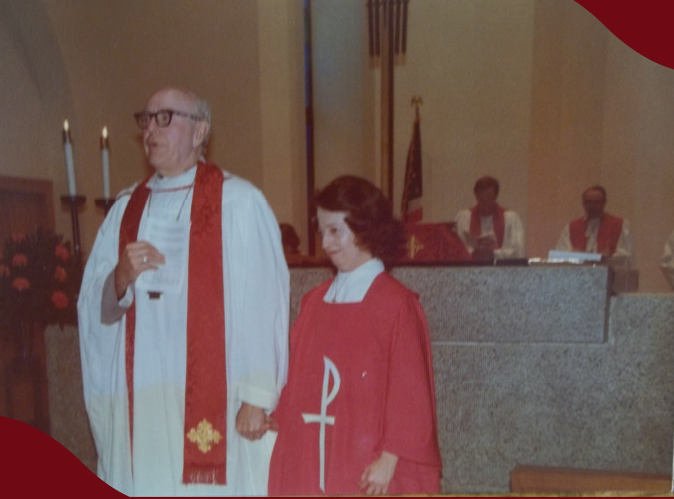
Within one year of the official resolution opening up the priesthood to women, the Diocese of Southern Ohio welcomed its first woman priest. The Rev. Doris E. Mote received her MDiv degree from United Theological Seminary. Prior to her ordination in 1977, she served as an associate at Christ Church, Dayton and continued to serve there until 1979. She eventually moved to New Albany, where she died in 2020. Mote is seen here at her ordination to the priesthood, January 29, 1977, at Christ Church, Dayton, with the Rev. Gordon S. Price, rector.
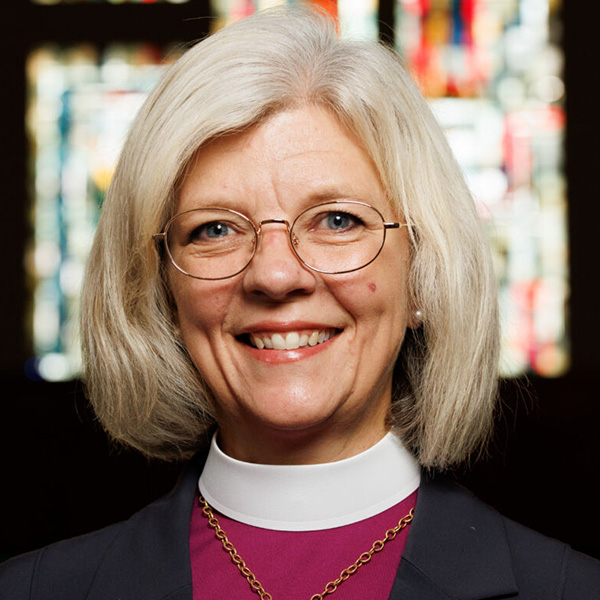
In 2024, the Diocese of Southern Ohio welcomed its first woman bishop, Kristin Uffelman White as its 10th Bishop. Educated at Cottley College (AA), Willamette University (MA), and Seabury-Western Theological Seminary (MDiv), Bishop White served as the Canon to the Ordinary for Congregational Leadership and Development in the Episcopal Diocese of Indianapolis immediately prior to her election as Bishop. She also previously served in Chicago.
The Reverend Gia Hayes-Martin described some challenges she has faced as a clergywoman:
“I had a senior warden early in my time at St. Bede’s [in California] who I thought I had a good relationship with…. I thought I was looking for a partner in ministry and he thought I was looking for someone to tell me what to do. When it became clear that I was not going to do what he told me to do—in fact I was going to push back on what he suggested because I didn’t agree with it – he began opposing everything I put forward and spent about eighteen months trying to get me fired. One of my closest male friends said, ‘it’s pure sexism Gia; that’s the only reason he’s opposing you, because his ego is hurt, and he can’t stand that this woman who is half his age is not doing what he wants.’… That guy ended up leaving the parish, which was probably the best thing for everybody, for him to move on.”
When asked how she discerned her call to the priesthood, The Rev. Nancy Hopkins-Greene recalled:
“I remember standing at St. Thomas in Terrace Park here when I was about—I know exactly how old I was, I was sixteen, before I moved to California, seeing a newspaper clipping of the ordination of the Philadelphia Eleven. Really, from that moment on, I wanted to be a priest.”
Deacon Theophilus (Top) Borden discussed her road to becoming an ordained deacon as an outgrowth of her desire to participate in the spiritual life of St. Simon of Cyrene Episcopal Church.
“…I wanted to be a reader. But at that time, they didn’t have women. Well, I’m going to keep asking. And I did, and I got to do that… While I was there Bishop (Michael) Curry was our parish priest. If you listened to him and you were never a believer, you would be if you finished. I talked to him about becoming a deacon. He said, ‘Well, you know, you’d have to leave St. Simon.’ I said, “Not really. I won’t be there physically, but this is my home, my church home.”
Becoming Beloved Community: Race, Reconciliation, Reparations
Throughout its history, the Episcopal Church, as with other denominations, often did not fully embrace those who were from marginalized communities. The Civil Rights Movement sparked increasing calls for justice throughout the nation. The Episcopal Church responded by looking to its own past, especially in terms of its Black congregants, working to address the historic inequity through the Becoming Beloved Community initiative and by seeking paths to reconciliation and reparations. For the Diocese of Southern Ohio, reparations is a discipline of repentance and repair following the way of Jesus, that reckons with historical and continuing wrongs against people based on their group identity. We acknowledge the offenses and seek to change our practices, both individual and institutional to heal what we can and move forward together with God’s help.
Historically Black Churches
There are currently four historically Black Episcopal Churches in the Diocese of Southern Ohio, many of which started as missions of an established congregation. Traditional histories do not reveal if someone “suggested” that Black Episcopalians might want to have their own church or if it was an effort initiated by the Black members themselves. Whatever the case, these historically Black congregations maintain a vibrant church community and are active in supporting and encouraging inclusivity throughout the diocese, as well as serving the people around them who are in need.
St. Philip, Columbus
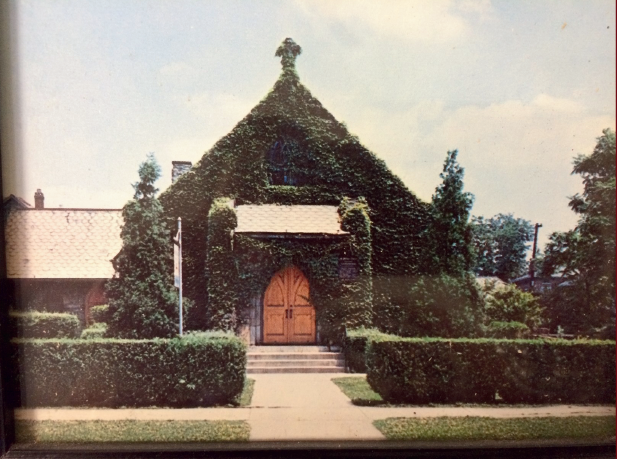
St. Philip Episcopal Church in Columbus began as a mission of Trinity Episcopal Church in 1891 and held its first service in what had been a saloon. After worshiping at Johnson’s Hall, the congregation built a new building, seen above, where they held their first services in 1895. The construction of Interstate 71 forced the congregation to relocate and build a new home. The current building was completed in 1962. St. Philip is a vibrant faith community that serves in many ways, from their food pantry to reading programs to tutoring, bringing dignity and hope to others.
St. Andrew’s, Evanston
As was the case with St. Philip in Columbus, interstate highway construction forced St. Andrew’s parish to move from downtown Cincinnati to the Evanston neighborhood in 1959. The church’s then-pastor, The Rev. Julien Simpkins, purchased a house there, which at the time was a predominantly white neighborhood. According to the Rev. Christopher Slane, current priest-in-charge, somebody burned a cross on the Rev. Simpkins’ lawn in protest. Eventually, most of the white population relocated to the suburbs. The neighborhood itself was later bisected by the construction of I-71 around 1970.
St. Simon of Cyrene, Lincoln Heights
In the 1920s, African Americans began moving out of the crowded West End of Cincinnati to what became Lincoln Heights. With the Great Depression, many people in this new community lost their jobs and their homes. in 1931, the Episcopal Society of The Transfiguration “responded to the spiritual, economic and social needs in the Woodlawn Terrace, currently known as Lincoln Heights. They purchased a small two-story house… which served as a center of mission outreach work in the community.” That same year, the Sisters started a school. In 1932, St. Simon of Cyrene parish dedicated the church building, which was later replaced in 1966. Although the congregation is now much smaller and the school itself closed in 1970, its members still serve the church and the community.
St. Margaret’s, Dayton
St. Margaret’s Episcopal Church in Dayton made history in 1983 when the Rt. Rev. Walter Decostre Dennis, suffragan bishop of New York, ordained Kelly Brown Douglas at St. Margaret’s as the first Black woman priest in the Diocese of Southern Ohio. Douglas was also one of the first ten Black women ordained by the Episcopal Church. She earned her MDiv and PhD at Union Theological Seminary in New York. Douglas later entered academia, where in 2018, she became the inaugural dean of the Episcopal Divinity School at Union, becoming the first African American woman to lead an Episcopal Seminary.
Bishop Herbert Thompson, Jr.

New York City native Herbert Thompson, Jr. became the first African-American Bishop of the diocese of Southern Ohio in 1992, after serving as Bishop Coadjutor beginning in 1988. He received his bachelor’s degree from Lincoln University, his MDiv from the General Theological Seminary and Doctor of Divinity from Hebrew Union College. One of Bishop Thompson’s lasting gifts to the city and the nation was his leadership in convening the Summit on Racism, which led to the founding of the National Underground Railroad and Freedom Center. He also oversaw the renovation of Procter Center and the hiring of the diocese’s first Hispanic Missioner, Richard J. Aguilar.
Bishop Thompson retired in 2005 and passed away in 2006.
Becoming Beloved Community: Welcoming and Affirming All
Historically, the Episcopal Church did not always welcome new Americans who were not from northern Europe. At the same time, the LGBTQIA+ community was invisible in the Episcopal Church. The changes in American society driven by the civil rights and other justice movements inspired the Episcopal Church to strive for inclusivity. The Becoming Beloved Community initiative is the outgrowth of the calls for equity for all peoples. Beginning in 2017, under the leadership of Bishop Thomas Breidenthal, key Episcopal Church leaders presented the Becoming Beloved Community vision– a practical and theological framework guiding Episcopalians to a “transformation of ourselves and of our communities of faith to dismantle racism and injustice in all of their forms.“ Parishes throughout the Diocese of Southern Ohio have implemented the imperatives of Becoming Beloved Community both formally and informally.
Welcoming New Americans
The United States is a nation of immigrants, many of whom have not always been welcome upon arrival. Throughout US history, people who were not white, Anglo-Saxon and/or Protestant faced a hard road to becoming American. Most recently, persons of color from places like Latin America have been viewed with suspicion and mistrust. The Diocese of Southern Ohio has made valiant efforts on the path of inclusivity to ensure that newcomers are made to feel welcome and beloved.
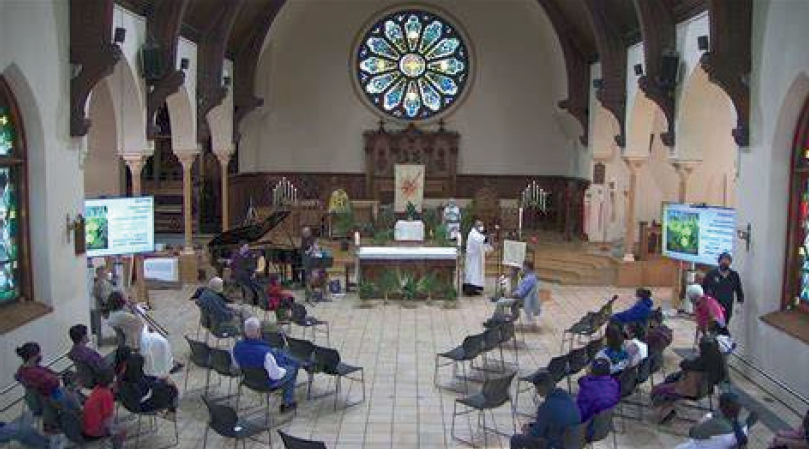
Cincinnati’s Mount Auburn neighborhood is home to the bilingual parish of Church of Our Saviour/La Iglesia de Nuestro Salvador. It did not start out as a Spanish-speaking parish, but in 1992, Mexican Episcopalians Mercedes and her daughter Tanya, began attending services. According to the Rev. Dr. Paula Jackson, “After that time, there was never a time where there weren’t at least a couple of Spanish speaking people in the congregation.” The parish instituted bilingual services and is involved in other social justice issues.
Becoming Open and Affirming
Full acceptance of others is a core Episcopal belief. According to Integrity USA, in 1978 the national Episcopal Church voted that the church must be “fully inclusive,” which includes gender identity. The Church added “non-discrimination” for ordination in 1994. The first openly gay bishop was consecrated in 2003, but the Church did not officially eradicate obstacles to consecration until 2009. In 2012, the Church allowed ordination of transgender persons. In 2015, the General Convention voted to amend the Church canons and allow for same sex marriage.
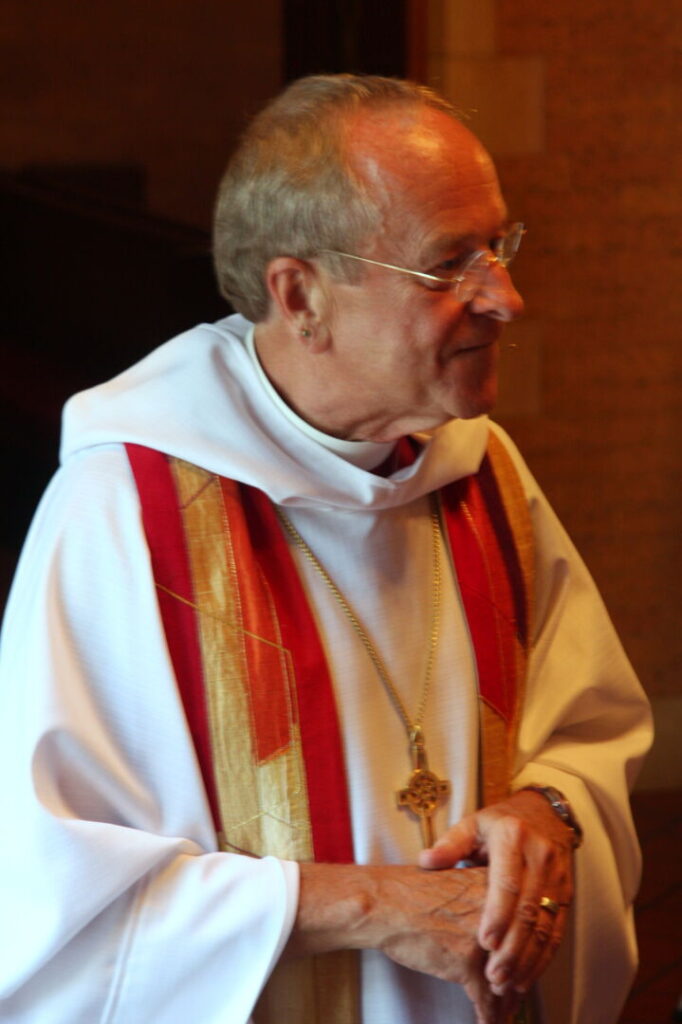
V. Eugene Robinson became the first openly gay elected Episcopal bishop in 2003. The Diocese of New Hampshire bravely voted for Robinson, despite the controversy of his sexual orientation. At his consecration, he wore a bulletproof vest for protection because of the animosity surrounding his elevation to Bishop. The threats to his life didn’t stop at his ordination. As late as 2013, in an interview with NPR, Robinson stated he and his husband, Mark were still harassed, “The death threats were plentiful, almost daily for a couple of years.” He added, “You know, we live in a time when if somebody wants to kill you, they’re going to kill you, and you can either go in a hole and, you know, pull the roof in over you, or you just continue putting one foot in front of the other and hope that you’re doing some good in the world.”
When the Rev. Michael Smith and his husband moved back to Cincinnati from Columbus they searched for a parish.
“We wanted a smaller place, a more intimate place, but also a place that was welcoming to LGBTQ people. And we found one, up in Mt. Auburn at Our Savior Church. That would have been in 1989, I think. And that was a really great place for us to be because of its commitment to serving people on the margins. That’s when I first began to realize there are people on the margins, myself included and my husband. We’re on the margins. There are people I know, who I taught over the years,
especially Black students and Native American students who are on the margins still. And here’s a church that seems to be dedicated to reaching out to people on the margins.”
Mary Jane Plote, diocesan postulant at the Seminary of the Southwest, spoke of her admiration for Becoming Beloved Community:
“Beloved Community is forever. Beloved community is, I think, when we say, we’re building the kingdom of God, that is a Beloved Community. It’s a community that seeks to see everyone as a beloved child of God, even when you disagree, even when it’s hard. I’m excited that I see my seminary, I see parishes, I see my diocese really continuing that work. It can get exhausting, but it’s important to keep going at it now.”
Challenges and Opportunities
Throughout its 150 years, the Diocese of Southern Ohio has faced many challenges – including two world wars, two pandemics, societal change, and economic upheaval. With a firm faith and optimistic outlook, the diocese continues to spread the Good News of Jesus Christ and welcomes all, no exceptions.
Economic Dislocation: Deindustrialization
Beginning in the late twentieth century, one of the major concerns facing the diocese has been deindustrialization. The job loss associated with industrial decline particularly impacted Appalachia and other rural areas, leading to a declining population as young people sought greater opportunities elsewhere. The Episcopal parishes in many places have struggled to survive. Some have shared clergy, while others have instituted new programs to draw people in. There are glimmers of light as clergy and congregants try to serve their parishioners and the larger community.
The Rev. Gene Hallahan, who serves at All Saints, Portsmouth and Christ Church, Ironton, described the impact of deindustrialization on the two communities:
“You could almost say it’s a level playing field in a certain sense on that. The other things is the fact that it has probably impacted the community in Ironton a little bit more because there was heavier industry there in terms of steel and stuff like that, because there were steel mills and stuff like that and of course a lot of them all across the river there in Ashland, where there was a much larger steel mill.”
Growing the Faithful
As the Diocese of Southern Ohio moved into the 21st century, many parishes experienced declining membership. Reaching out to the larger community through programming, charitable efforts, and outreach activities are a few things that have helped to encourage new members. The deep held belief that “All Are Welcome; No exceptions” has had a positive impact in providing a safe haven for many who feel dispossessed.
John Glaze described outreach programs at St. Mary’s, Hillsboro:
“We have a program of a free meal once a month, which isn’t keeping anyone from hunger but, it’s a start. It’s one thing we can do. We try to participate in the county fair; have a presence there. I have a music program, ‘Music at St. Mary’s,’ where we provide concerts at no cost.”
Being Episcopalian

The future of the Diocese of Southern Ohio is very much on the minds of the faithful as they mark the Sesquicentennial. The following quotes give an idea of their deep faith and their hope for the years to come.
“I really love the church…. I always felt nurtured and respected and encouraged. Anything that I’ve accomplished, any intellectual abilities I have, any musical ability which is much diminished, but I still love it; my career. It’s all been encouraged and nurturing. If we can offer that to people, I think that’s the best we can do. Just help people to be their best, to be whoever God is asking them to be or calling them to be…. We just have to be who we are and be comfortable in that definition.”
Joseph Rutter, Parishioner
St. Stephen’s Columbus
“There’s a tremendous sense of joy that I find in Episcopal parishes —at least ones I’ve been involved in. There’s a tremendous sense of joy—joy about their faith, joy about the Gospel, joy about what they’re doing for people on the margins. There’s just a sense of joy. And a lot of humor about all of that. I find that interesting. Some of my family and friends who come to Episcopal things with me have said, “Oh, they’re kind of a little sacrilegious.” I said, ‘It’s not that at all. It’s being very comfortable.’”
The Rev. Michael Smith,
Cincinnati
“I think it [the Episcopal Church] has a good motor, let me say that—in the people that worship in those different churches. There’s seventy-one in the diocese. It won’t be as it has been, but they will still preach the Gospel in the way they live their lives.”
Deacon Theophilus (Top) Borden
St. Simon of Cyrene, Lincoln Heights
“I think for one thing—and this may not be what other people think, but it’s what I think—I think even though there are doctrines, I think you’re free to believe them or not believe them. I think you’re encouraged to bring your brain and ask hard questions and wrestle with what you’re doing.”
Robin Holland, Parishioner
St. Philip, Columbus
“I just love this church [St. Andrew’s] so much. I think every priest that I’ve ever met who served here, loves this church. Every person who’s visited this church, loves this church…It’s one of the cornerstones of the African American community. So many leaders of the African American community…of Cincinnati have come out of this church and continue to come out of this church.
It’s just a real blessing to be able to serve this place and to be able to see about trying to make it an important community hub as it has been. I think that’s really important for Black churches not to become insular but to continue in that Civil Rights era idea that the Black church is at its best when it’s doing things for and with the community—especially a community like ours, which is really in need of attention and has been ignored for so long. I think it’s a beautiful place to do ministry.”
The Rev. Christopher Slane, Priest-in-charge
St. Andrew’s, Cincinnati
Download this history as a pdf file
Tell Your Story!
Click here to send an email to our historian, Donna DeBlasio
