
by Ted Dziemianowicz (St. John’s, Worthington) and the Rev. Karl Stevens (St. Stephen’s, Columbus) for the Commission on Reparative Justice
When St. John’s in Worthington began an historical preservation project in their churchyard in 2023, one of the goals was to compile as definitive as possible a list of the burials, both marked and unmarked. Worthington was settled by a band of mostly Episcopalian families from the Connecticut Valley who arrived in Ohio in 1803-1804, having previously plotted out the New England village they would set up, including an Episcopal church and churchyard on one corner of the village green. From the first burial in 1804, St. John’s churchyard served a dual purpose as both church and village burying ground until 1859 when Walnut Grove, the municipal cemetery was established. Among the burials recorded in 1830/1831 were those of two children of Benjamin Lee, an emancipated slave who came to Ohio in 1817, married Nancy Jordan, and raised a family. They were buried in unmarked graves in the southeast corner, diagonally across the churchyard from the spot where the church was then under construction, the earliest recorded African-American burials in the area. Based on other entries in the sexton’s log, it’s believed that this part of the churchyard served as a sort of Potter’s field, with few, if any, of the graves marked with permanent monuments. Potter’s Fields were the burial places of the poorest people in a community. Until the establishment of Black Burial Societies, they were the only places where Black people could be buried.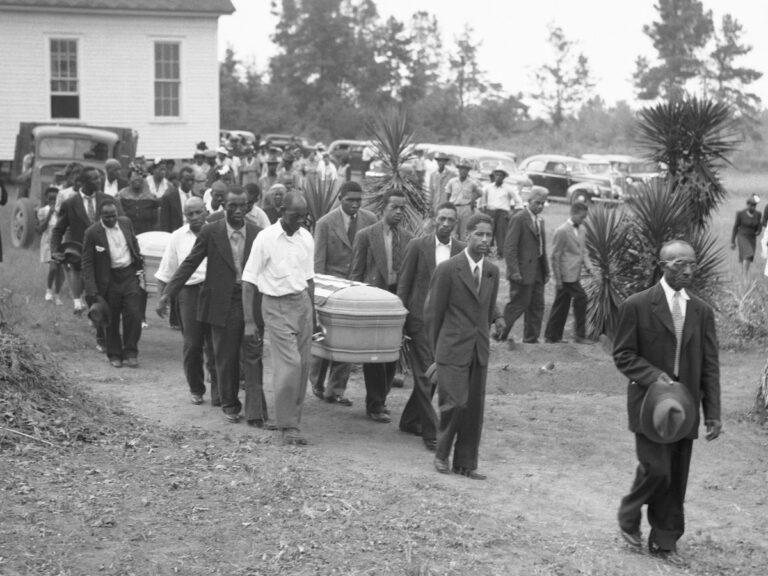
In 1832 an English Quaker named Edward Adby visited Cincinnati. A friend took him to see the Potter’s Field, and he noticed something odd. White people were buried with their feet facing East, as was common with Christian burial, since it was assumed that Christ would come from the East on the Day of Resurrection. The hope was that the dead, rising from their graves into their resurrection bodies, would face the living Christ as he descended. Adby noticed that Black people were buried laying north to south, as if to prevent them from facing the right direction when Christ came and thus, presumably, diminishing the moment of resurrection for them. He was staggered by this realization.
“There is no state in the Union that has carried out its enmity to these people as far as Ohio,” he wrote. “The pride of the white man pursues its victim even beyond the grave…I saw the unchristian distinction amid all that is calculated to humble the pride of man: and I wished that the shame of Cincinnati might be known in every village in Europe.”
Kept from the opportunity to be buried with dignity, Black people began to organize burial societies. The first was organized by Richard Allen and Absalom Jones in Philadelphia in 1778. The “Free African Society” was a mutual aid community. Members were expected to attend meetings and be in church on Sunday. They collected dues and then distributed these dues according to need, attending to people in both sickness and death. They also purchased land for Black cemeteries.
In 1847, the United Colored American Association (UCAA) of Cincinnati purchased land in Avondale for a Black cemetery. When the United Colored American Cemetery (UCA Cemetery) was established in 1848, Avondale was a rural area. Seventeen years later, Avondale had become an incorporated village, and the white leadership tried to restrict burials in the cemetery. Lacking the legal power to order the UCA Cemetery to close, a group of powerful white property-holders went to the state government and lobbied for a bill that would allow the Avondale Board of Health to declare the cemetery a nuisance and close it. This despite the fact that the UCA Cemetery abutted a German cemetery which wasn’t deemed to be a nuisance or in need of closure. At an 1880 meeting at the Allen Temple, the Black community gathered to hear Peter H. Clark speak. “The aristocracy of Avondale should not forget that this cemetery existed long before their village. We bought it. It is ours by right of purchase. We went out there in the country to get out of the way from the white men who seemed to hate us, dead or alive.”
The state acted and the UCAA had to find land for a new cemetery. In 1882 they purchased 11.6 acres between the villages of Oakley and Madisonville. At the dedication ceremony, they sang an old hymn by Isaac Watts:
Hark from the tombs a doleful sound
My ears attend the cry
Ye living men! Come view the ground
Where you must shortly lie
Princes! this clay must be your bed
In spite of all your towers
The tall, the wise, the reverend head
Must lie as low as ours
Their struggle for dignity after death was shared by other Black communities throughout the nation. These communities created something beautiful from that struggle. Burial Societies became a force for economic stability and growth in Black neighborhoods. Their dues helped to pay for the establishment and maintenance of Black-owned funeral homes, which began to take on a greater and greater role. Funeral homes became community centers, where dances and other celebrations were held. They became clinics, as hospitals capped the number of Black patients that they would treat. Hearses functioned as ambulances, driving the sick or injured to the funeral homes for treatment. During the Civil Rights era, leaders were secretly driven from place to place in these hearses, evading the racist white authorities. In Cincinnati, as in other places, the Black community responded to oppression with energy, wit, and innovation.
As parishioners Ted Dziemianowicz and Jennifer Maier pored over later church records (a parish register was begun by the Rev. Erastus Burr in 1833), an unexpected pattern emerged: many members of Worthington’s growing Black community had their funerals at St. John’s in the mid-1800s even though they never appeared in the church’s list of communicants. In fact, a funeral was held for a member of the Carter family in 1849 despite this family appearing on an 1847 list of members of the local Methodist church. All told, 16 funerals were held for Black people at St. John’s between 1849-1871, and while only one burial in 1858 can be confirmed by a surviving gravestone, none of the other deceased appear in records of other local cemeteries, including Walnut Grove.
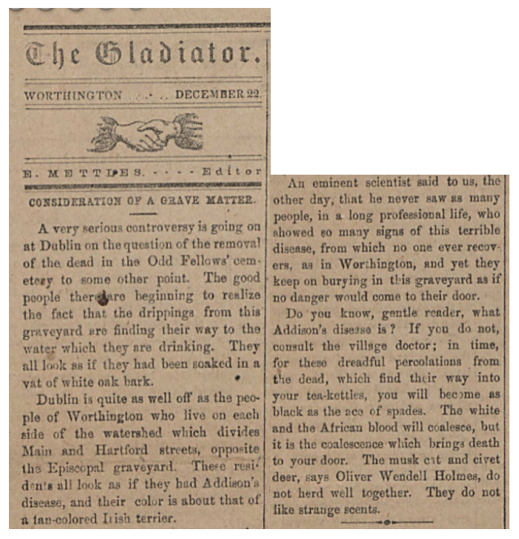
In 1887 an editorial appeared in the Worthington Gladiator, castigating the parish for its burial practices. The author claimed that Black bodies in St. John’s churchyard were contaminating the local water supply, spreading disease and changing the skin tone of the neighborhood’s white residents. While church records are not clear on how many of the 16 were interred in the churchyard after the municipal cemetery had opened in 1859, we take the timing and tone of the Gladiator article to mean it was a significant number.
As a diocese, we continue the work of countering racial harm and making reparations to the Black community. It is a long and slow process, requiring much ingenuity and steadfast commitment. We have the example of the burial societies to guide us as we seek ways of repairing the breach that are rooted in community and mutual love. We have the example of St. John’s and other predominantly White Episcopal parishes that took a stand even when it was hard and prominent racist voices opposed them. Reparation, in all of its myriad and surprising forms, is part of the heritage that we seek to claim in our present work.
Works Cited:
Black Deaths Matter
United Colored Association Cemetary
1887 Gladiator Editorial
