
by the Rev. Julia Joyce-Miesse, St. Luke’s, Granville
“Then the king will say to those at his right hand, ‘Come, you who are blessed by my Father, inherit the kingdom prepared for you from the foundation of the world, for I was hungry and you gave me food, I was thirsty and you gave me something to drink, I was a stranger and you welcomed me, I was naked and you gave me clothing, I was sick and you took care of me, I was in prison and you visited me.’ Then the righteous will answer him, Lord, when was it that we saw you hungry and gave you food or thirsty and gave you something to drink? And when was it that we saw you a stranger and welcomed you or naked and gave you clothing? And when was it that we saw you sick or in prison and visited you?’ And the king will answer them, ‘Truly I tell you, just as you did it to one of the least of these brothers and sisters of mine, you did it to me.’” Matthew 25:34-40 NRSVUE
Two weeks ago, I walked into the Market Street Pantry, a ministry of St. Luke’s Episcopal Church, Granville, and saw volunteers stocking shelves, folding bags, and loading food boxes into customers’ cars. I saw the work of discipleship happening in front of my eyes…the relationships that have been formed between our volunteers and our customers, the sharing of stories, the feeding of the hungry, the love of God shared between each interaction. I saw God at the Market Street Pantry. I also saw fear in the eyes and sharings of the volunteers as they told me how the amount of food they usually received from the Licking County Food Network has been steadily decreasing. One day, there was no protein to pick up from the network, and the produce was limited to onions and potatoes.
When I returned to the church, I began to research the decrease in food and learned of the new cuts proposed for food pantries, the ending of federal government programs, and what could be a real problem for our ministry. I also learned of the good work of the Hunger Network in Ohio and an invitation to join them to interface with our legislators.
On Tuesday, March 25, 2025, over one hundred people gathered at Trinity Episcopal Church on Capitol Square to advocate to our state legislators regarding the proposed budget and how it would impact those experiencing hunger. We urged support for the child tax credit proposed by Governor DeWine, free and reduced school lunch programs, and affordable housing.

Faith leaders throughout the state, under the leadership of the Hunger Network in Ohio (HNO), and representatives from the Poor People’s Campaign were divided into small groups and assigned three to four meetings with state representatives and senators. One of the key topics included the cutting of 7.5 million dollars from the food pantry budget which crashes at the same time that the USDA ended the Community Agriculture Program, an opportunity for small farmers of produce and protein to receive market value for their crops, eggs, and meat and in turn they are given to food pantries around the state. A loss of these needed foods and the budget cuts will be catastrophic for the people facing food insecurity. Local food pantry directors and volunteers shared lived experiences of the rise of the need to depend on the food pantry to supplement the groceries in some families and entirely feed families in others. HNO shared, “We support amendment HC 0286 to restore the funding cut and adjust for inflationary pressures ($4.93 million) on costs of food.”[1]
Another concern brought by advocates included the need to keep the reduced/free school lunch program. Advocates shared that the food given in our schools may be the only meals some children eat. Retired educators reminded lawmakers that hungry children can not learn and that these minds will care for our state in future years. A policy recommendation from the Hunger network included HC 1213, which would “fund a universal school breakfast and expand eligibility from the 185% Federal Poverty Level (FPL) to 225% of the FPL.”[2]

Nurse advocates reminded legislators that the medical fallout from the decrease in the availability of produce and protein will be more expensive. Eating in the middle of a grocery store, foods that are shelf stable and processed, will lead to increased blood pressure and blood sugars, resulting in higher medical costs for hypertension, diabetes, heart disease, and strokes. The call to care for our people now will lessen the number of people seeking medical care in an already overwhelmed system.
Advocates also highlighted the need to continue the Medicaid program for those who qualify, sharing their experience deciding between prescription medication, whole foods, and paying rent. Many shared the truth that a large portion of the population could be one tragedy away from being unhoused, uninsured, and hungry.
For other advocates, their priority was to highlight a growing need for safe and affordable housing. The Ohio Housing Trust Fund was often funded by the Ohio general revenue and funds from people who refinanced their homes. As the reality of a drop in refinancing has come to pass, the amount of money in the fund has been impacted. HNO shared, “We support Amendment HC 1086 to support fully funding the Ohio Housing Trust Fund at $65 million. We also support Amendment HC1309 to strengthen funding for legal aid services in Ohio who are on the frontlines in helping tenants avoid costly evictions.”[3]
At a press conference in the middle of the day, held in the George Washington Williams room, many advocates held posters that read “Budgets are a Moral Document,” a theme shared by Deacon Nick Bates of the Hunger Network in Ohio. Bates reminded the legislators that our budgets share where our priorities lie, and they should be taking care of the hungry, the sick, and the unhoused.
In our individual meetings, we found legislators and aides who agreed with us and said they would continue to push their colleagues toward the amendments that would serve those experiencing hunger and financial hardships. We were also met by lawmakers who shared that they were not moved to change the budget because they did not believe there was as serious a problem as we were sharing. I invited every person we met to come and see our Market Street Pantry, hear the stories of hard-working people who have fallen on more challenging times, and see how the current decline in food will impact many lives. I left praying that God would soften the hardened hearts and move them toward caring for God’s people.
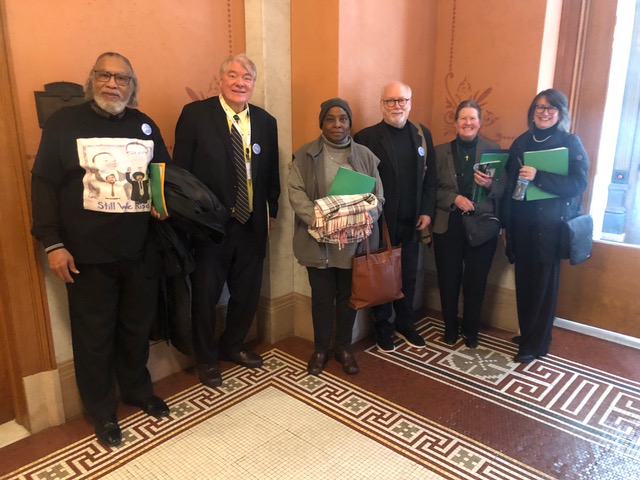
I was continually moved by the lived experience sharings from many of the advocates. The story of hunger is not happening in a place far away…it is in our cities, neighborhoods, and possibly the experience of our friends. I heard a story of children pumping gasoline before school to receive quarters in return that the children would use to buy a Little Debbie to fill a belly that had not had anything to eat since the free lunch at school the day before. I sat and listened and thought about the food waste we may participate in by not consuming what we can purchase at the grocery store. I am moved to do better and participate in programs that will fill the bellies of our hungry siblings in Christ. Food is not a luxury. Food is a first-level Maslow requirement for survival.
We believe that advocacy is the work of Becoming Beloved Community, and we invite all in the diocese to continue to pray for our elected leaders, for wise actions, and for the caretaking of God’s people. We would also like to invite everyone to get involved in our local food pantries, The Garden for All, and other programs that can do the work of feeding God’s people.
[1] Hunger Network in Ohio, “Policy Recommendations” handout given to legislators and advocates on 3-25-2025 and can be found on www.hungernetohio.com
[2] Hunger Network in Ohio, “Policy Recommendations” handout given to legislators and advocates on 3-25-2025, and can be found on www.hungernetohio.com
[3] Hunger Network in Ohio, “Policy Recommendations” handout given to legislators and advocates on 3-25-2025 and can be found on www.hungernetohio.com
