
Race and Racism in Cincinnati: Moving from Awareness to Action
May 8 at Calvary, Cincinnati, 6:30 to 8:30 p.m.
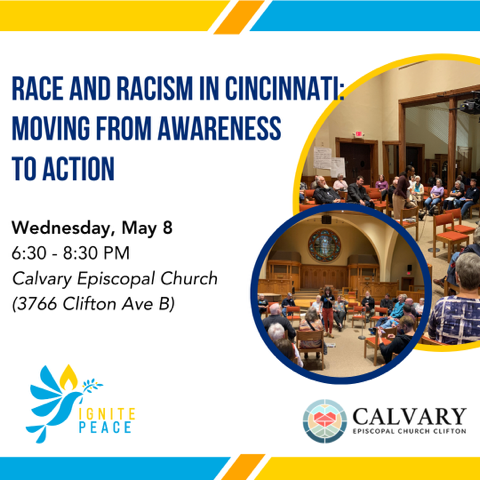
The Cincinnati nonprofit Ignite Peace, which was founded as the Intercommunity Justice and Peace Center by Catholic nuns, produced a three-part documentary series called “Race and Racism in Cincinnati,” and is inviting the community to discuss “How do I dismantle systemic racism in Greater Cincinnati?” at Calvary Episcopal Church, 3766 Clifton Avenue. Register here.
Race and Racism Documentary screening June 7, 14 and 21
“Race and Racism in Cincinnati,” Ignite Peace’s 3-part docuseries, is the telling of Cincinnati’s history from the racial margins, a history that is not often told in school curriculums or in mainstream (white) culture. Over 1,000 people have seen the documentaries. Ignite Peace will offer a virtual screening of the series again on three consecutive Fridays in June from noon to 2, starting June 7, via Zoom.
This video series shares a people’s history that places storytelling authority in the hands of common people, rather than political leaders or other figure or power who have crafted narratives to benefit their agenda. It includes three separate hour-long videos that each tackle a different time span, starting from Cincinnati’s birth and bringing us to the present day. Each viewing will be followed by a facilitated discussion. Buy tickets here.
Vote expected soon on two energy justice bills in Ohio House: how you can help
Two bills that will save Ohioans money on their utility bills have a strong chance of passing in the Ohio House before the summer recess. Both would help reduce carbon emissions and air pollution. By reducing peak demand, both bills would save all ratepayers money and will make the grid less vulnerable to blackouts. Here’s an update on the status of HB 79 (energy efficiency) and HB 197 (community solar) and how you can share your views immediately.
- HB 79 would restore energy efficiency programs killed by HB 6 in 2019, but make participation voluntary for utilities. Co-sponsored by the powerful Rep. Bill Seitz (R-Cincinnati) and Rep. Rose Sweeney (D-Westlake), HB 79 was expected to come up for a Ohio House vote April 24, but was pulled because the sponsors were not sure it had enough votes to pass. The sponsors hope to get it on the agenda for May 8. This link will enable you to email your views to your Ohio House Representative immediately.
HB 79 allows utilities to create rebate programs to help consumers afford energy efficiency retrofits to lower their energy bills. The bill specifically makes efficiency technology available and affordable to low-income families across Ohio to reduce their energy burden, a major factor in housing insecurity. Episcopal churches and the community emergency assistance programs they support struggle to help households facing utility shut-offs, with need vastly exceeding available funds in many areas.
- HB 197 would authorize community solar programs across Ohio to customers served by the major investor-owned utilities for the first time. The bill has strong bipartisan support in the House Public Utilities Committee, whose chair plans to hold a final hearing and possible vote on May 8. Here’s the link to email your views to the committee.
Three members of the Diocese’s Creation Care and Environmental Justice Committee have already submitted testimony in favor of this bill. Here’s why: HB 197 would make savings available to households and businesses for whom rooftop solar is not feasible, including tenants and small businesses. The four-year pilot program would authorize small projects totaling up to 1,500 MW, enough to power up to 300,000 homes, and allow subscribers to save from 5-20% on their bills through credits from their utilities. Other ratepayers would not incur any cost for these projects, which could be developed by both businesses and non-profits including houses of worship.
Gerrymandering: Serving self or serving God and neighbor?
Ohio voters have the opportunity to curtail corruption and restore our state legislature’s accountability to voters by qualifying the Citizens Not Politicians constitutional amendment for the fall ballot. Diocesan Council passed a resolution endorsing Citizens Not Politicians.
Ross, Fayette, Hocking, and Pike County have momentum! Can you help us reach the goal of collecting signatures number equal to 5% of the turnout in the last governor’s election in those counties or other rural counties? If we succeed, the campaign will meet the requirement of 44 counties hitting that threshhold in order for the measure to qualify for the ballot. Let us know about upcoming community events and whether petition circulators can gather at your church. Please email me if you can help.
A challenge to put Episcopal faith into action
Last Thursday’s oral arguments before the US Supreme Court on the scope of presidential immunity spotlights a question that is becoming increasingly destabilizing in the United States. Who has rights? What rights? What holds the three branches of our government accountable to the needs and rights of people? Do we still have an effective and robust separation of powers, or will one of the three branches seize disproportionate power at the national or state level, which it can exercise with impunity to protect selfish interests?
Heather Cox Richardson, a professor of American history at Boston College, published a powerful essay April 28 on the clash between safeguarding the rights of ordinary people and the “unitary executive” theory which has emerged in the last four decades. She matches several examples of the expansion of presidential power with the erosion of voters’ rights and voice through increasingly precise and powerful gerrymandering and Supreme Court decisions like Shelby v Holder. That ruling ended the 1965 Voting Rights Act preclearance of changes in voting laws, which was enacted to ensure they did not impede African-Americans’ equal access to voting and fair representation. This ruling has been followed by a wave of state laws restricting voter access which disproportionately impact people of color and poor people.
Unfortunately, these trends are being justified by distorted representation of both Christian faith and constitutional history. “In 2019, [then Attorney-General William] Barr explained to an audience at the University of Notre Dame the ideology behind the strong executive and weakened representation,” Richardson writes. “Rejecting the clear words of the Constitution’s framers, Barr said that the U.S. was never meant to be a secular democracy. When the nation’s founders had spoken so extensively about self-government, he said, they had not meant the right to elect representatives of their own choosing. Instead, he said, the founders meant the ability of individuals to ‘restrain and govern themselves.’ And, because people are willful, the only way to achieve self-government is through religion.
“Those who believe the United States is a secular country, he said, are destroying the nation. It was imperative, he said, to reject those values and embrace religion as the basis for American government.”
Do you think this view of God’s plan fits our Baptismal vows, Jesus’ actions in the Gospel, and the discernment by the early Christian community that God’s love is open to Gentiles as well as Jews?
There are two means of protecting against corruption and oppression. One is equal application of the laws, and the other is ethics, with which compliance is voluntary unless enforced by agreed-upon processes for review and sanctions. An example of ethics’ frailty without such processes is the controversy over whether the US Supreme Court will adopt an enforceable and effective ethics policy. Currently, justices are under no obligation to recuse themselves when they have a conflict of interest.
The citizen-sponsored Citizens Not Politicians amendment to Ohio’s constitution – for which many Episcopalians are collecting signatures to qualify for the fall ballot – is designed to help prevent legislative corruption by specifying that neither current elected officials nor lobbyists can serve on the commission that draws Ohio’s electoral districts. This reform would do a better job of protecting the public from a legislature that can act with impunity, as they did in defying all of the Ohio Supreme Court’s seven rulings finding that the district lines they drew in 2021-22 were all unconstitutional for disproportionately favoring the majority party. In other words, the commission’s majority drew the lines to preserve their legislative seats and power.
As part of the Episcopal faith community, we benefit from weekly ethical reminders and disciplines defining who we serve, and how. These include readings and preaching on the Prophets, Gospel, and epistles, the accountabilities listed in the confession and Prayers of the People, and the renewal of our Baptismal vows. Despite this, we can still go out and act selfishly. We acknowledge our repeated failures by including “I will, with God’s help” in each vow.
I became an Episcopalian because I see all of these commitments and reminders as a faithful representation of Jesus’ teaching and action, pointing to the love of God which includes everyone. On Saturday, at the Greater Cincinnati Earth Day Festival, I was volunteering in an interfaith booth and we were all horrified by a self-identified Christian group that used a bullhorn to broadcast hate-filled attacks on a number of targets including environmentalists and “homosexuals.”
Trust is withering among all sides. On Friday I heard a state legislator speak to a Rotary meeting about his fear that his rights to farm as he sees best (he cited using pesticides and fertilizer) are under threat from a government that doesn’t know anything about his profession. He lamented that he sees the United States’ identity as a Christian nation under attack. University professors are testifying to their dread that SB 83 will prevent them from teaching honestly about the racial history of the United States or outlaw DEI efforts to correct current practices that disproportionately harm minorities.
The need for reconciliation and restoration of faith in our civic institutions is huge.
We have such an important opportunity this year to convey God’s all-embracing love to fellow Ohioans and to invite them to vote to protect every one of us equally by restoring accountability in our state government.

Advocacy updates are compiled by Ariel Miller, a longtime community advocate and member of Ascension & Holy Trinity, Wyoming. Connect with her at arielmillerwriter@gmail.com.
