
Call your Ohio Rep immediately on “controversial beliefs and policy” higher ed bill
The Ohio House could vote Wednesday on SB 83 to constrain how Ohio’s public colleges and universities teach about “controversial beliefs or policy,” which the bill specifies as including diversity, equity, and inclusion and climate policy. On Dec. 6, the House Higher Education Committee suddenly voted 8-7 to refer SB 83 for a vote by the full House, with the chair refusing to hear any of the submitted testimony before acting on the bill! The Ohio House has a session this Wednesday (Dec. 13) at 2 p.m. SB 83 could come up for a vote. If it passes, that would send it to the Governor to be signed into law.
The summary below from the Ohio Capital Journal explains why this bill is highly concerning to Episcopalians who support our Church’s commitment to overcoming racism and to our commitment to stewardship of creation, including climate action and environmental justice. Please contact your Ohio House Rep immediately with your views on SB 83. You can find your rep speedily by going to the Ohio Legislature home page and putting in your address in the box “Who Represents Me.” That takes you to photos of your Ohio Rep and Senator. Click on the picture of the Representative and you’ll reach their home page which provides their office phone number. Also please call Speaker Jason Stephens (R-Kitts Hill) at 614-466-1366.
“SB 83 prohibits mandatory diversity, equity and inclusion training unless the training is mandatory to comply with state and federal law, professional licensure requirements or to get accreditation or grants,” reports the Ohio Capital Journal. “The bill defines controversial beliefs or policy as ‘any belief or policy that is the subject of political controversy, including issues such as climate policies, electoral politics, foreign policy, diversity, equity, and inclusion programs, immigration policy, marriage, or abortion.’
“The bill would allow students to ‘reach their own conclusions about all controversial beliefs or policies and shall not seek to indoctrinate any social, political, or religious point of view.’”
Even though Speaker Jason Stephens told reporters the previous week that the bill did not have enough votes to pass in the House, members are being pressured by the Senate leadership to support it.
Help stop partisan gerrymandering in Ohio
The nonpartisan Citizens Not Politicians coalition, which includes the League of Women Voters and Common Cause Ohio, has started to collect signatures to qualify a constitutional amendment for Ohio’s November, 2024 ballot. The goal is to stop partisan gerrymandering in Ohio by creating a Redistricting Commission that excludes elected officials and lobbyists. The current Redistricting Commission is entirely composed of elected officials. The Citizens Not Politicians coalition is holding frequent Zoom training for petition circulators. Fair Districts Ohio is holding its next All-Volunteer Huddle Dec. 13 at 6 pm. Register here.
I am recruiting volunteers from faith communities in Southern Ohio. Please email me if you can help. Volunteer roles include:
- Recruiting and coordinating teams at the city or county level
- Collecting signatures
- Office work such as validating signatures
- Organizing events and find locations.
- Giving short speeches at events.
The statewide campaign is building a calendar of public events like music and art festivals, parades, sports events, and so forth. They will have petition booklets and local hubs to return them.
If you have leadership/management skills to shepherd these teams, foster friendships, and celebrate milestones, you could accomplish a great deal to build civic hope and engagement. It’s also a wonderful opportunity to reach out to the universities and colleges in our communities to help young citizens rebuild hope in American democracy. Many students reported trouble with voting in November and were forced to submit provisional ballots. It would be so powerful if they could contribute to – and experience – a success next year.
When elected officials control redistricting, they have a built-in conflict of interest to preserve their power and majority. This is true of both parties. When they create “safe” instead of competitive districts, the most ideological members of the dominant party in that district are most likely to vote in the primary, which determines the winner instead of the general election. This leads to legislatures made up of people increasingly unwilling to find middle ground. Gerrymandering has fueled the dysfunction in Congress and the seemingly endless bills that go against the majority views of voters on racial justice, public education, climate solutions, and gun safety.
Webinar: State of the Climate 2023-24 with Project Drawdown’s Dr. Jonathan Foley; Dec. 13 at noon
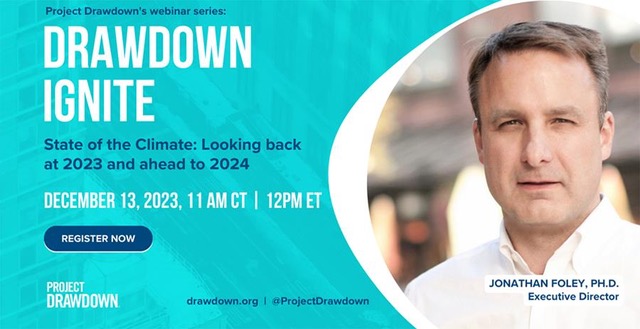
From climate-fueled weather disasters to the Inflation Reduction Act and COP28, climate change has been in the headlines throughout 2023. Most sobering are warnings from the Intergovernmental Panel on Climate Change (IPCC), the US National Climate Assessment, and other experts that the world needs to reduce greenhouse gas emissions dramatically if we are to avoid the worst impacts of climate change.
Project Drawdown is one of the world’s leading nonprofits teaching climate solutions grounded in scientific data. Executive Director Dr. Jonathan Foley shares top news from 2023 and what Drawdown will be tracking in 2024. This webinar is part of Project Drawdown’s monthly Drawdown Ignite webinar series. Register here. Visit Drawdown’s Events page for updates on future webinars.
Advocacy briefings are compiled by Ariel Miller, a longtime community advocate and member of Ascension & Holy Trinity, Wyoming. Connect with her at arielmillerwriter@gmail.com
