
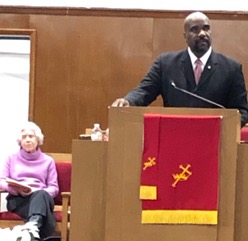
On Jan. 14, the Hon. Kenneth L. Parker, United States Attorney for the Southern District of Ohio, gave the annual Martin Luther King Day talk at Cincinnati’s historic Zion Baptist Church. He reminded Cincinnati’s interfaith leaders of the dream that Dr. Martin Luther King articulated for our nation: equal rights and protection under the law, safe working conditions, jobs that pay a living wage, and access to effective, affordable health care. He explained the quest of the Justice Department to prevent hate crimes targeting people of color, faith communities and their houses of worship, and LGBTQ+ people.
Parker is leading the rigorous federal prosecution of the corrupt Ohio officials who accepted bribes to pass HB6. They won the conviction of Ohio’s former House Speaker Larry Householder and have recently won an indictment of former Public Utilities Commission chair Sam Randazzo. Parker and his team in Cincinnati, Dayton, and Columbus are fighting a tidal wave of deadly drugs, illegal guns, and other perils. But we have to do our part by saving democratic institutions which are under attack: the conduct of elections, the peaceful transfer of power, and accountability to voters to serve their constituents and accomplish basic tasks like passing legislation and budgets.
Legislatures in the United States increasingly come from uncompetitive districts because of gerrymandering. Both parties do it when they are in the majority, control redistricting, and don’t have to comply with fairness rules. This is the door to corruption, and those in power are appealing to hatred and fear to inflame the base voters in primaries so they will turn out to keep these corrupt people in office.
Our faith community is also in the crosshairs. In the last part of this update I’ll summarize the legislative attacks on efforts like the Episcopal Church’s to understand and overcome racism in ourselves and our institutions. The kind of work we’re doing in Becoming Beloved Community is being framed as a danger to young minds. As this misdirection and projection gathers momentum, institutional racism and bias are stunting lives and increasing the danger of death from violence, chronic disease, and prematurity or complications of childbirth.
One of the most important actions we can take in 2024 is to restore representative districts in Ohio by passing a constitutional amendment to stop partisan gerrymandering. This is achievable! It’s a quest supported by concerned citizens of both parties and it is designed to restore equal voice to all voters regardless of their party or views.

In August, 2023, Ohio voters reserved their century-old right to amend the state constitution by a simple majority vote. This year we have the chance to pass a constitutional amendment called Citizens Not Politicians. It was drafted with bipartisan support including Ohio’s retired Republican Chief Justice Maureen O’Connor. This amendment would prevent elected officials – with their built-in conflict of interest – from being able to draw electoral district maps to preserve their power so that their primary accountability is to large donors, not the majority of ordinary citizens.
“The Episcopal Church reaffirms that one person one vote means that the votes of all citizens of all races and ethnicities are fairly represented, counted and accounted for,” says General Convention Resolution 2018-D003. “We oppose any form of partisan gerrymandering which has the same effect of racial gerrymandering.”
Those of us who support fair districts are striving to collect at least 700,000 signatures from eligible Ohio voters by June to ensure we have the almost 414,000 verified signatures needed to qualify for the ballot. The work is non-partisan, designed to protect every voter’s voice, and led by a statewide coalition including the League of Women Voters of Ohio, Common Cause Ohio, and many other groups including the faith-based Hunger Network in Ohio, for which I am a board member.
Here is how you can learn more about this proposed amendment:
- Fair Districts Ohio Redistricting Toolkit including redistricting basics, slide decks, talking points, recordings, and additional resources.
- Volunteer sign-up for petition circulator training, messaging advice, helping with office work, speakers’ bureau, and other roles.
- Request speakers for your church, civic group, community council, etc.
Please email me if you get involved so that we can work together and encourage each other across the Diocese.
The Episcopal Church has passed a wealth of resolutions supporting the goals that Dr. King articulated for a Beloved Community. Presiding Bishop Curry and his staff have joined this generation’s leaders of the Poor People’s Campaign to carry on the work that Dr. King launched before his assassination.
This week I have been reflecting on the examination of conscience we’ve been doing together through our church’s Sacred Ground curriculum and the prayer and discussions we’ve been immersed for the goal of Becoming Beloved Community. I would like to summarize news of the past two and half years in Ohio on the increasingly virulent attacks by our state legislative leaders on this civic and spiritual discipline.
Our study of US history and current events, and our work root out racism in ourselves and our institutions, are now being framed as dangerous to our children and youth. We and our work are the evil – not institutional racism. Work like ours is being attacked for promoting “divisive content,” rather than racism and the deadly disparities in health, education, housing, and income that it causes.
Remember that the Ohio School Board passed a resolution in the summer of 2020 with specific actions to overcome the bias and harm to children of color that they found amply documented in study of data from our state’s school districts. Members of that board were bullied into resigning when they would not vote to repeal the resolution. Last summer, our state legislature stripped the Ohio School Board of its authority over curriculum.
This winter, the Legislature could pass SB 83, which essentially bans mandatory diversity, equity, and inclusion programs at Ohio’s public universities. It prohibits faculty from endorsing “controversial beliefs or policies” – defined as “any belief or policy that is the subject of political controversy, including climate policies, electoral politics, foreign policy, diversity, equity, and inclusion programs, immigration policy, marriage, or abortion,” allowing students to “reach their own conclusions about all controversial beliefs or policies.” Faculty and universities “shall not seek to indoctrinate any social, political, or religious point of view – ” in other words, they would have to present “both sides.”
I’ve written about Supreme Court decisions, gerrymandering in Ohio, and new restrictions on voting access that erode the civil rights protections of the Voting Rights Act. I’ve documented the impact of gerrymandering in creating non-competitive districts that insulate elected officials from having to pay attention to the concerns of the majority of Ohioans over gun safety, climate change, and reproductive rights. If you would like to read a summary of the corruption scandals, their impact, and the disconnect between our legislative leaders and our citizens over the past three years, email me and I will send you this summary, with references.

Advocacy briefings are compiled by Ariel Miller, a longtime community advocate and member of Ascension & Holy Trinity, Wyoming. Connect with her at arielmillerwriter@gmail.com.
