
Help calm rage and prevent political violence
The attempted assassination of former President Trump on July 13 generated an array of responses, ranging from calls for reconciliation to blaming the Biden Administration for the assault. This event intensifies the challenge we’ve been facing for years now: how to speak and act bravely in the name of Jesus as the risk of political violence escalates.
This post summarizes what’s at stake, offers some resources from our faith and from history, and invites you to join in helping our communities to revive shared values so we can come together to choose our better angels.
As part of our “duty to our neighbors,” the Catechism in the Book of Common Prayer calls us “to be honest and fair in our dealings, to seek justice, freedom, and the necessities of life for all people, and to use our talents and possessions as one who must answer for them directly to God. To speak the truth, and not to mislead others by our silence.” (p. 848).
Our faith community’s ability to help
In a phone meeting last week with the Rev. Karl Stevens, leader of the diocese’s Reparations Task Force, we brainstormed what Episcopalians in Southern Ohio can do as a faith community. That includes “spiritually preparing people to deal with a world that will be incredibly complicated,” Karl said, “insisting on a hope I don’t always feel.” To do that, he urges that we share the history of victories that faith communities have helped to win against terrible odds. He recommends Rebecca Solnit’s Hope in the Dark.
Also click here to read the July 9 diocesan Advocacy Update citing Maria Stephan’s article “Faith and the Authoritarian Playbook” in Sojourners Magazine. She lists many of those victories and links to a number of practical toolkits. “Churches can bring their moral and symbolic power, organizational and communications networks, multiparty congregations, and a faith-rooted, disciplined capacity for nonviolent resistance to the broad-based, pluralist social movements that are key to advancing democratic governance,” she writes, providing examples ranging from the civil rights victories of the 1960’s to this year.
“As of February 2024, more than 300 churches in Florida had created ‘freedom schools’ with Black history programs to push back on Florida governor Ron DeSantis’ efforts to remove diversity, equity, and inclusion programs, block Black history in public classrooms, and ban more than 1,000 book titles focused on race,” she writes. “Ordinary people, when organized and inspired, can spur extraordinary change. Our faith traditions may inspire us — but to be effective we also must be organized, and we must act.”
Here are actions Karl and I discussed. Your input is welcome!
- Communicate clearly what we are FOR, in the name of Christ.
- Convene Episcopal and interfaith teams at the city or county level. The Rev. Meribah Mansfield, who helps to launch our diocese’s Becoming Beloved Community work, shares this inspiring news story on how St. Michael in the Hills is working to build trust, fellowship, and community in Toledo during the months ahead.
- Provide preaching and pastoral resources.
- Organize events and study groups to build a shared base of information on current dynamics, and mobilize the spiritual resources we can use to restore trust and peaceful resolution of conflicts. The Episcopal Church calls on us to identify and combat misinformation.
- Work to protect voters and election officials. Here is the link to the Episcopal Church’s Election Engagement toolkits.
- Continue to advocate for laws and policies that protect the vulnerable, especially those who are being scapegoated: people of color, immigrants, and LGBTQ+ youth.
Please email me if you’d like to help.
What’s at stake
One of the core principles of democracy in America is to maintain institutions that allow us make decisions and resolve conflicts without violence. The Episcopal Church has worked for years to protect free, fair elections and the rights of all people to safety and justice.
What we are facing now is a proliferation of fear and projection, both vastly accelerated by social media. In addition, we live in a state whose legislature has significantly weakened gun safety laws over the past few years, including passing a Stand Your Ground law that expands Ohioan’ rights to fire in self-defense in any public space where they are legally present, as Kyle Rittenhouse did in killing two people at a Black Lives Matter protest in Wisconsin. The Ohio law removed a shooter’s duty to retreat if possible instead of using deadly force.
A clear danger right now is that the legitimate policy discussions that voters need during an election will be derailed by the accusation that these are inciting violence. A number of members of Congress are blaming President Biden for the assassination attempt. Yale historian Timothy Snyder posted an article July 14 on precedents in political violence from Europe and Russia where right-wing politicians were assassinated by more extreme members of their own movement.
On July 14, Boston College historian Heather Cox Richardson quoted President Biden’s speech following the assassination attempt: “[a] former president was shot” and “an American citizen killed while simply exercising his freedom to support the candidate of his choosing…. There is no place in America for this kind of violence or for any violence ever. Period. No exceptions. We can’t allow this violence to be normalized.”
“The framers of the Constitution, he said, ‘created a democracy that gave reason and balance a chance to prevail over brute force. That’s the America we must be, an American democracy where arguments are made in good faith, an American democracy where the rule of law is respected, an American democracy where decency, dignity, fair play aren’t just quaint notions, but living, breathing realities.’
“Biden rejected the idea that criticizing the Republicans’ extremism was polarizing. While they can ‘criticize my record and offer their own vision for this country,’ he said, ‘I’ll continue to speak out strongly for our democracy, stand up for our Constitution and the rule of law, to call for action at the ballot box, no violence on our streets. That’s how democracy should work.’
Be clear what we stand for
“There are different kinds of fights,” wrote the Rev. Diana Butler Bass on July 14. “There are fights of the raised fist and fights of holding hands. There are fights we start for ourselves and fights we find ourselves in for others. There are fights for revenge and retribution and fights for love and justice. They are those who fight with whips and fists and those who fight with maps and prayers. There are things that must be defied. We must never give up, not as long as we are strong and able. Even when we want to surrender. Even when we feel lost. Even when afraid.”
As contrast to the violent, she cites Harriet Tubman and Frederick Douglass, born, like Bass, on Maryland’s Eastern Shore. “Once in a while, when it seems like there’s no path forward, we’ve got to get our bearings. Regain strength. Take a moment and reorient. Breathe. There is, however, no confusion of the destination — that land of freedom. But the journey is not easy. This place is full of tangled brush and watery detours. And blocked roads, wild beasts, and those intent on sending us back.
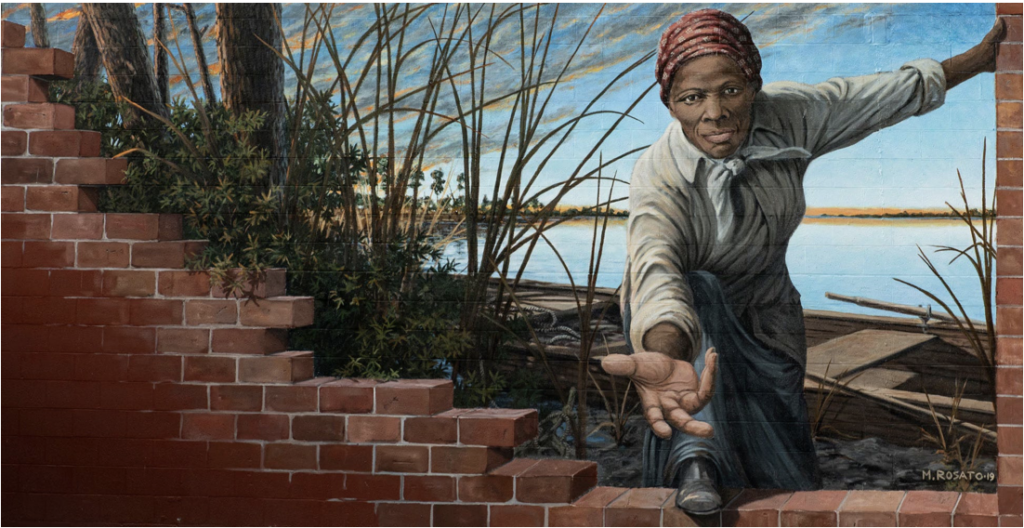
“But Harriet is there to guide. And Frederick. And the countless American saints who embodied the defiance of liberating love for others. Those who have held hands for the sake of their neighbors.”
For five years now, our diocese has been centered on the Four-Way Path of Becoming Beloved Community to heal the harms of racism, and we have centered the protection of people oppressed or endangered, including people of color, immigrants, and LGBTQ+ people. This includes telling the truth about history and current conditions, proclaiming the dream of what Beloved Community looks like (such as fair districts, voting rights, and economic justice), repairing the breach, and practicing the way of love.
Response from our faith community
Proclaiming the dream – how we believe God is calling us to live – is central to Episcopal and ecumenical responses from our branch of the Jesus movement.
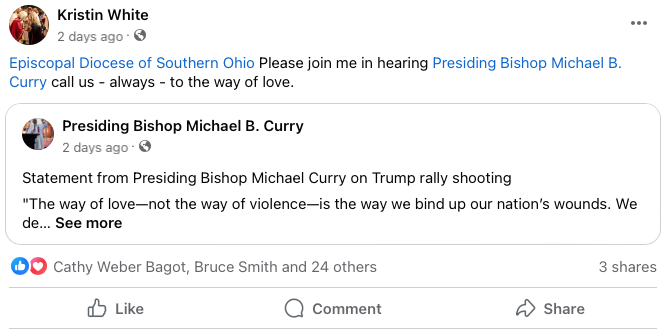
Bishop Kristin Uffelman White immediately posted Presiding Bishop Michael Curry’s response on Facebook: “The way of love—not the way of violence—is the way we bind up our nation’s wounds. We decry political violence in any form, and our call as followers of Jesus of Nazareth is always to love. We pray for the families of those who were killed. We pray for former President Trump and his family and for all who were harmed or impacted by this incident. I pray that we as a nation and a world may see each other as the beloved children of God.”
“On behalf of the 18 denominations that comprise the Ohio Council of Churches, I write to express condemnation of the firearm-related assassination attempt that injured Former President Donald J. Trump, claimed the life of a spectator, and injured two others during a Pennsylvania rally on Saturday, July 13, 2024,” wrote the Rev. Dr. Jack Sullivan, Executive Director of the Ohio Council of Churches, on July 15. “We believe all people, regardless of party or perspective, must be able to express their political ideas without fear of violence or intimidation. It is abundantly clear to us that violence has no legitimate place in the realms of political discourse and in our society itself. Mr. Trump, the family of the slain spectator, the injured, and the family of the shooter will be in our prayers.”
By contrast, Ohio Senator JD Vance posted on X, “The central premise of the Biden campaign is that President Donald Trump is a fascist who must be stopped at all costs. That rhetoric led directly to President Trump’s attempted assassination.” Georgia Congressman Mike Collins accused President Biden of ordering the assassination attempt.
“The shooting not only intensified the already passionate support among Trump’s base as his seeks to again win the presidency but also raised profound questions about the increasingly violent rhetoric within U.S. politics, political science professors told The Dispatch Sunday,” wrote reporter Jack Wolf in the Columbus Dispatch on July 15. “Christopher Devine, a political science professor at the University of Dayton, underscored the unprecedented nature of this event in the digital era. With no direct historical parallel in the United States in the age of social media, Devine highlighted the rapid dissemination of information and speculation, which could exacerbate existing political divides.
“‘The speed at which information — and misinformation — spreads can deeply influence public perception and political reactions,’ he said. Devine expressed concerns over immediate partisan responses, particularly citing U.S. Sen. J.D. Vance’s quick move to blame political adversaries.
“‘Political figures are attempting to politicize the situation by blaming Joe Biden and other Democrats. This is reminiscent of past instances where, unfairly, political figures have been blamed and is dangerous as it will only heighten tensions.'”
Diana Butler Bass offered this counsel after the assassination attempt: “Breathe. Again, breathe. Look up and know that you aren’t alone. Reach for a hand. Let us pull one another across the line to freedom.” She quotes Harriet Tubman: God’s time is always near. He set the North Star in the heavens; He gave me the strength in my limbs; He meant I should be free.
Advocacy updates are compiled by Ariel Miller, a longtime community advocate and member of Ascension & Holy Trinity, Wyoming. Connect with her at arielmillerwriter@gmail.com.
