
Ohio Episcopalians are brainstorming ways to support clergy and laypeople as they preach, write, and design action to support a fair, inclusive, and violence-free election and transition of power. We need many voices! Please write me if you’d like to be part of an editorial team writing blog posts, or of a regional team — such as Central Ohio, the Miami Valley, or Appalachian Ohio — to plan action. Christian nationalism is the opposite of Jesus’ call for beloved community, and we are called to live into the third Baptismal vow “to proclaim by word and example the Good News of God in Christ.”
Resources for Addressing Political Violence
The Episcopal Church Office of Government Relations offers resources on addressing political violence here.
- The Council on Foreign Relations’ warning signs of political violence
- The Crisis Prevention Institute’s four steps to de-escalation
- Faith in Public Life’s video providing de-escalation training for people of faith
- The “Defending Democratic Institutions” page of the Center for Strategic and International Studies, a bipartisan, nonprofit think tank, and
- The Cybersecurity and Infrastructure Security Agency’s “Guide to Generative AI” and its “Rumor v. Reality “page.
“Election violence and its threat to U.S. democracy impacts all of us, and we have a responsibility to respond in a way that promotes peace and understanding in times of great tension,” writes the Office of Government Relations. “As leaders in the Episcopal community, we can prepare by being familiar with the threats of political violence, practicing de-escalation in tense moments, and having a response ready to share with your community if political violence continues.”
Vote Faithfully Election Engagement
The Episcopal Church’s Vote Faithfully Election Engagement Toolkit 2024 is posted online in English and Spanish. In addition to the resources listed above, this page connects to:
- The link to volunteer as an Episcopal Election Activator
- Season Three of the Episco-pols Podcast
- A curriculum for promoting Civil Discourse
- “Misinformation, Disinformation, Fake News: Why do We Care?”
Parts of this toolkit were developed in collaboration with the Evangelical Lutheran Church in America, the United Church of Christ, and Interfaith America. These resources are non-partisan and are provided to equip Episcopalians to protect the rights of every eligible voter and to reduce the risk of political violence. “It is a Christian obligation to vote, and more than that, it is the Church’s responsibility to help get souls to the polls,” writes Presiding Bishop Michael Curry.
Communications toolkit and bulletin inserts for Election Engagement
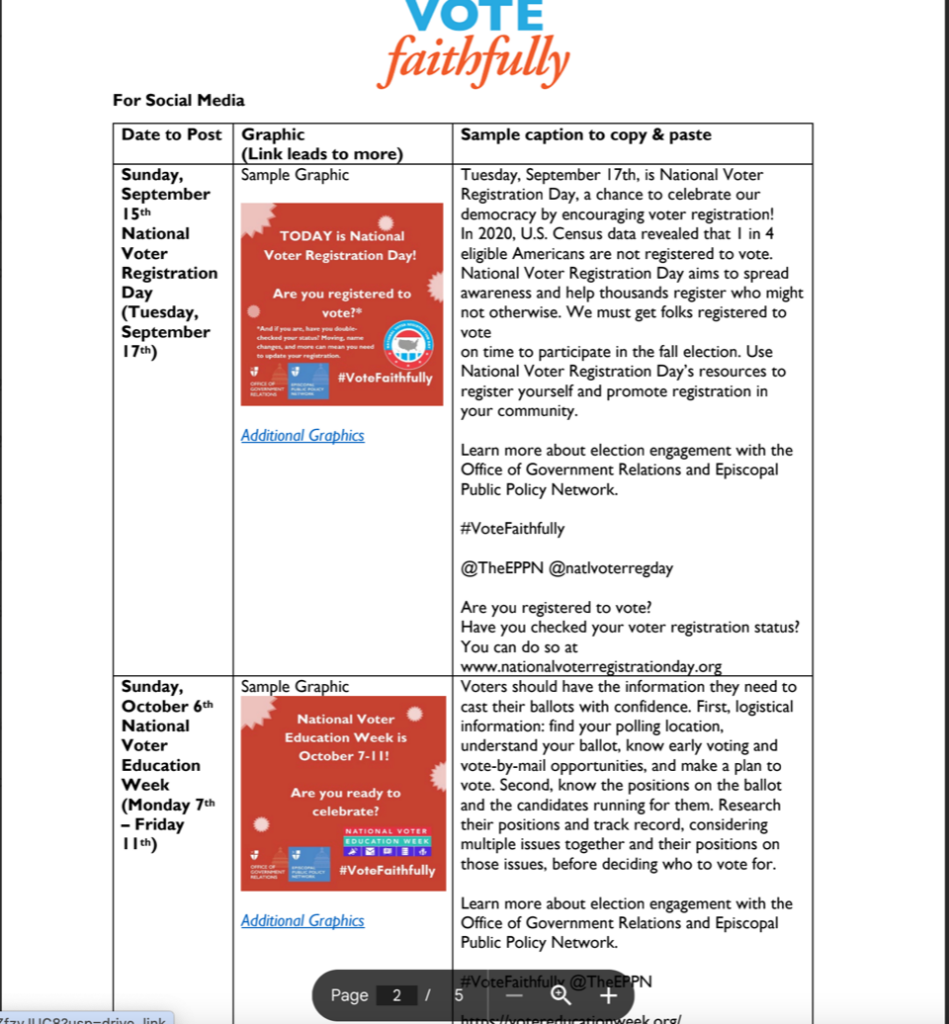
The Office of Government Relations offers this link to a Google drive folder from which you can download bulletin inserts for six Sundays during the general election, as well as an array of social media graphics supporting election engagement. The folders include both English and Spanish versions. Several of the graphics include website urls, social media handles, or QR codes. Browse through and see which ones work for your congregation and community.
Here are the Sunday themes:
- National Voter Registration Day (Sept. 15)
- National Voter Education Week (Oct. 6)
- Why Does Voting Matter? (Oct. 13)
- Misinformation (Oct. 20)
- Vote Early Day (Oct. 27), and
- Vote Faithfully Sunday (Nov. 3)
“Getting souls to the polls isn’t just about casting our own vote but helping everyone eligible vote faithfully,” adds the EPPN. “We can empower every voice in our congregations in this work.
The toolkit and links above include many resources, ideas, and ways to act. Doing election engagement well does not mean taking on everything there is to do and being overwhelmed. Effective election engagement begins with looking at your community’s needs, what resources, skills, and interests you and your church have, and then proceeding based on how that capacity can help meet those needs.
For some, this may be offering your parish as a polling site, for others it may mean election worker recruitment. For many it’s persistent messaging in newsletters and bulletin boards, for others it’s organizing child care on voting days. Whatever your path, I hope you are inspired to do more as a faithful Episcopalian modeling healthy and constructive civic engagement. All election engagement work must be non-partisan, and please heed local laws, election details, and Episcopal safe church practices as you promote voting.
Advocacy updates are compiled by Ariel Miller, a longtime community advocate and member of Ascension & Holy Trinity, Wyoming. Connect with her at arielmillerwriter@gmail.com.
