
Help Ohio children access summer food benefits
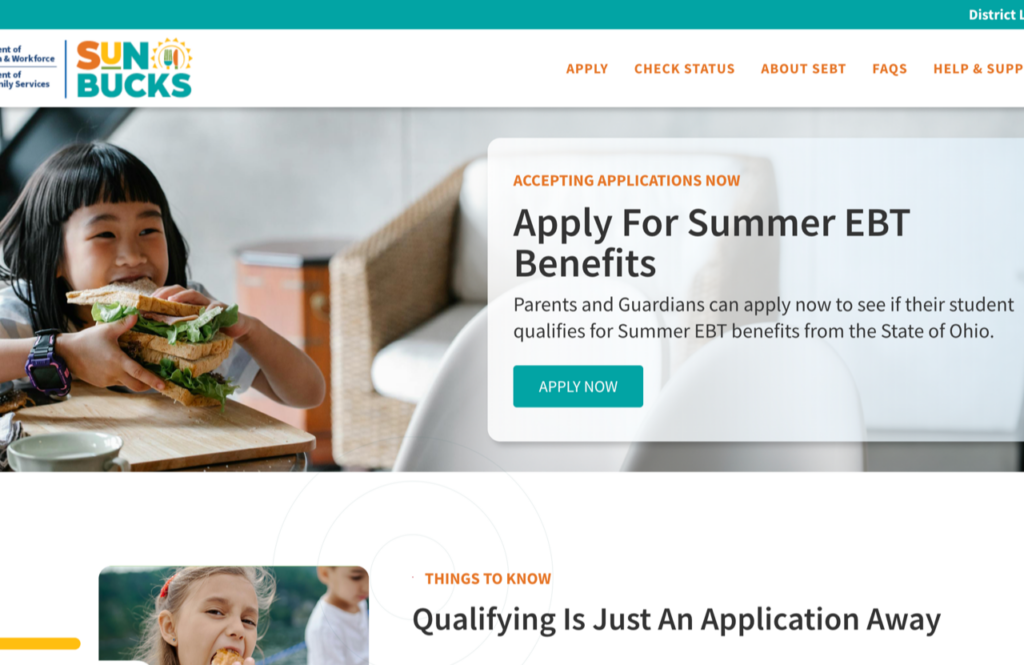
Sun Bucks is a summer food program which provides $40/month to eligible students. Families are automatically enrolled if they receive free school meals, or are enrolled in SNAP, Ohio Works First, or Medicaid (if income-eligible). Here is the link to the state application. If your congregation is part of a community food ministry, please publicize it!
Advocate for bills to reduce hunger for college students and senior citizens
The Hunger-Free Campus Act (HB 590) would create a grant program to help colleges and universities address hunger on campus. It has been referred to the Finance Committee, chaired by Rep. Jay Edwards (R-Nelsonville). Rep. Edwards, who spoke powerfully about hunger in the Hocking Valley at the ecumenical hunger advocacy luncheon earlier this year, is a co-sponsor of HB 428, which would increase the minimum SNAP benefit for eligible Ohio seniors from $23 a month to $50 a month. Our ecumenical partner Hunger Network in Ohio has sign-on letters on the Hunger-Free Campus Act and the $50 minimum monthly SNAP benefit for seniors.
Episcopal Public Policy Network asks your help on immigration policy
Last week EPPN shared the Episcopal Church Office of Government Relations (OGR) statement on President Biden’s Executive Order on Asylum, which reads in part: “The Episcopal Church supports the right to asylum, insisting that “our governments adhere to the internationally accepted principle known as non-refoulement, that stipulates that countries should not return migrants and refugees to unsafe conditions in their home countries or other countries.” We oppose any measures that dehumanize migrants or deny them access to asylum, a fundamental right under international law. Instead, we urge for compassionate and humane solutions that recognize the inherent worth and dignity of all people and empower migrants to continue adding their gifts and experiences to our country.
“We oppose President Biden’s recent Executive Order, which would restrict asylum access and prevent legitimate asylum claims from being adjudicated. The Episcopal Church recognizes ‘the legitimate need to protect borders and address security threats to sovereign nations.’ Yet this policy goes far beyond legitimate ways to manage the border and instead puts vulnerable people at risk.”
The June 6 EPPN newsletter describes the increasingly fraught social and political context over immigration in the US: “The U.S. immigration system is in desperate need of reform, and the politics of immigration in the United States are troubling: anti-immigrant and dehumanizing rhetoric is increasing; Congress is unable to act; and the Administration is taking action to limit the rights of asylum seekers. Nearly half of Americans have said they would support mass deportations of undocumented immigrants, and religious groups that carry out a call to serve all of God’s children are being targeted for their care of the most vulnerable.”
Acknowledging these realities, the Episcopal Office of Government Relations has developed a resource pageincluding advocating for immigration reform by Congress, supporting local ministries, and changing the conversation about immigrants. “For Congress to enact legislation that we support, the politics of immigration need to change – with so many Americans supporting mass deportations and members of Congress winning elections on anti-immigrant platforms, we need to shift public opinion to have a chance at successful legislation,” OGR writes. “We need to educate our neighbors that immigrants are part of our communities and benefit all of us.
“We need to clarify misinformation that wrongly equates vulnerable migrants with drug traffickers and other false narratives about immigrants. We need to share stories of the successes of how we can enrich each other by living in community and helping those fleeing persecution and harm. We need take seriously the responsibility to speak with clarity about our immigration system, classifications for immigrant populations, and legal processes as they are now and as we wish them to be.”
A good way to start is by learning what’s happening in your community and what would relieve the growing trauma of immigrants and the struggles of local nonprofits to respond. Examples include the fact that even those granted status to apply for asylum need to wait for months to receive work permits. Congress’ failure to pass any immigration reform means that the country has a huge shortfall of qualified judges and other staff to process asylum claims, which has caused a massive backlog of cases.
Members of the Immigrant Dignity Coalition in Greater Cincinnati are discussing what solutions would be a practical and humane alternative to the President’s setting a daily cap on the number of people allowed to apply for asylum, regardless of whether they would qualify.
“It is one thing to stand against the Executive Order but any advocacy should be able to provide possible solutions that could be used in regard to the Southern Border,” wrote one member. She went on to describe how unused military bases received Kosovar refugees and started the asylum case review while they were living on the base.
“Refugee Status OR Asylum Granted would be best,” she added. “Humanitarian Parole is not meant for such things and has made a mess for the Afghans and the Ukrainians…It has mucked up the immigration system farther than it already is. The asylum seekers would have medical care on-site; they could be assigned cooking or clean up duties; the base could have basic English classes so they would have a little English when they leave. We also used the military bases when the Afghans arrived. ALL 50 States would have to take a certain amount of immigrants so no state is overwhelmed or bearing the brunt of the influx.
“Many are facing homelessness and hardships as they come into crowded cities. We know that this leads to additional trauma, frustration, depression, and a greater possibility of them being trafficked,” added Sheryl Rajbhandari, executive director of Heartfelt Tidbits, an amazing nonprofit which mobilizes a multitude of congregations, nonprofits, schools, and volunteers in Greater Cincinnati to help refugees and other immigrants adjust and succeed here. Several Episcopal congregations are part of this network.
“At Heartfelt Tidbits, we are feeling the pain of the increased asylum seeker population. Every program has doubled in size, we are offering additional program sessions to help with community building, depression, employment, enrichment, and general case management. Yet our staff size, nor funding hasn’t increased, so we’re leaning on volunteers. If [asylum applicants] were to arrive on old military bases then this gives agencies, state, and city officials to determine where these individuals can be placed to have a greater chance of success.”
Stay tuned on Farm Bill
Interfaith advocates for food security are anxiously monitoring Congresssional negotiations over the Farm Bill, which shapes the country’s major food security program SNAP (formerly food stamps). The Farm Bill also determines foreign food aid programs at a time of catastrophic famine in many parts of the world. You can follow updates on the Farm Bill negotiations on the advocacy blog of the Evangelical Lutheran Church in America. We’ll keep you posted on action alerts.
Plain Dealer explores impact of new ban on foreign contributions to ballot issue campaigns
A new law passed by the General Assembly in their special session at the end of May prohibits contributions to ballot issue campaigns by foreign nationals, including legal permanent residents of the United States. Andrew Tobias of the Cleveland Plain Dealer published a fascinating article on the negotiations over the bill and the impact it could have on dark money groups (both progressive and conservative) and citizen voice, which generating many constitutional amendment campaigns as voters become increasingly concerned about the General Assembly’s adopting policies that go against majority views.
Signed immediately by the Governor, this law is widely understood to target the Sixteen Thirty Fund, which gets funding from a Swiss legal permanent resident living in Wyoming, and which contributed to the campaigns to stop the legislature’s push to require a 60% majority to pass a citizen-sponsored constitutional amendment (defeated resoundingly by Ohio voters last August), the campaign to put reproductive rights into the Ohio constitution, and this year’s bipartisan Citizens Not Politicians campaign to stop partisan gerrymandering.
The Ohio Secretary of State, currently Republican Dave Yost, is in charge of enforcing the ban, rather than the bipartisan Ohio Elections Commission. The major way to enforce it would be to subpoena a list of donors, which could affect 501(c)4 organizations on both the right and left. These lists would become part of the public record.
“When the law was first introduced, an informal coalition of conservative-leaning groups based in Ohio – led by the Buckeye Institute, a Columbus-based think tank that’s received funding in the past from the Koch Brothers – became concerned that it might inadvertently open nonprofits to potential investigation or being forced to reveal their donors,” Tobias reports. The law was changed to say recipients could not “knowingly” accept donations from a foreign national.
Ohio law already bans foreign nationals from contributing directly or indirectly to candidates.
Advocacy updates are compiled by Ariel Miller, a longtime community advocate and member of Ascension & Holy Trinity, Wyoming. Connect with her at arielmillerwriter@gmail.com.
