
Racial gap in voter turnout growing, meaning millions of votes are missing in an era of razor-thin election margins
The Brennan Center recently released a detailed data review of voting turnout since the U.S. Supreme Court’s 2013 Shelby County v Holder decision, which ended the 1965 Voting Rights Act requirement that counties and states with a history of racial discrimination in voter access would have to get permission from the Justice Department for any changes in voting rules. The voter turnout racial gap had been declining since the Voting Rights Act was passed, but “unfortunately, our research shows that for more than a decade, this trend has been reversing,” say authors Kevin Morris and Coryn Grange. This gap is growing fastest among young voters, according to a study by Michael Podhorzer.
“The racial turnout gap — or the difference in the turnout rate between white and nonwhite voters — is a key way of measuring participation equality. We find that the gap has consistently grown since 2012 and is growing most quickly in parts of the country that were previously covered under Section 5 of the 1965 Voting Rights Act, which was suspended by the Supreme Court in its 2013 decision in Shelby County v. Holder,” write the Brennan Center researchers. “The turnout gap grew almost twice as quickly in formerly covered jurisdictions as in other parts of the country with similar demographic and socioeconomic profiles.”
This study is relevant to Ohio because our legislature passed several new restrictions on voter access following the 2020 election, including new photo ID requirements, shorter early voting periods, and restricting drop boxes to one location per county.
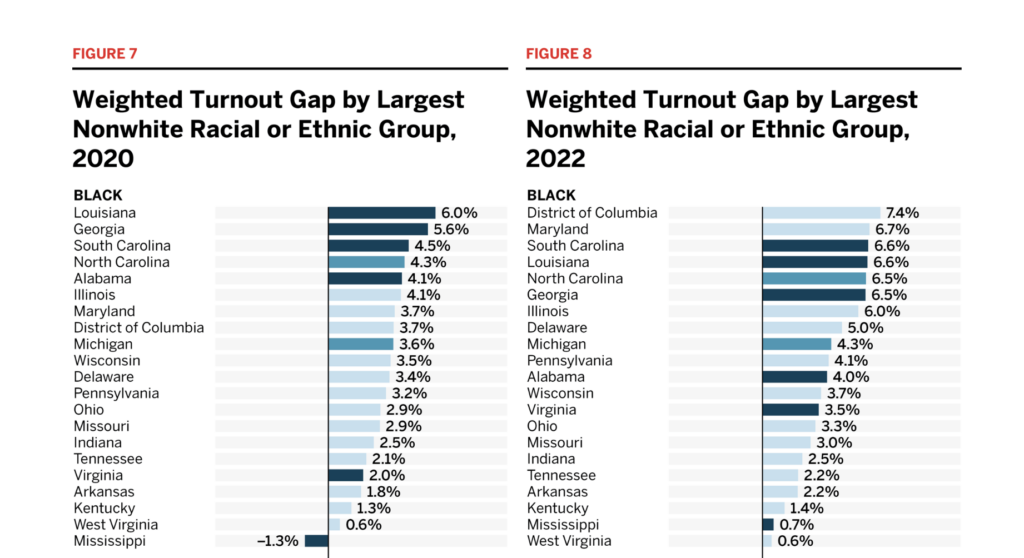
This chart from the Brennan Center study shows that the racial turnout gap between Black and white Ohioans grew between 2020 and 2022.
“We show that the racial turnout gap has grown everywhere,” the Brennan Center researchers add. “In all regions, the gap in the 2022 midterms was larger than in any midterm since at least 2006… That gap costs American democracy millions of ballots that go uncast by eligible voters.
“The study identified a significant racial turnout gap nationwide, beyond the counties previously covered by Section 5,” writes New York Times reporter Nick Corasaniti in his March 4 summary of the Brennan Center study. “In the 2020 election, 9.3 million more people would have voted if nonwhite voters had participated at the same rate as white voters. In the 2022 midterms, that total would have been 13.9 million ballots.
“The gap persisted across education and income lines. Though turnout drops across all racial and ethnic lines in lower-income communities, poorer white voters still turn out at a higher rate than their nonwhite peers, according to the study.
“The widening turnout gap is a ‘big deal,’ said Jake Grumbach, a professor of policy at the University of California, Berkeley. ‘Democratic institutions in the U.S. were getting healthier since 1965. And this is the first time the trend has reversed, really, in the post civil rights era. And so I think that’s the damaging point.’
Corasaniti continues: “Many other factors contribute to voter turnout. Still, the total number of “missing” votes is most likely large, the study contends.
“By the 2022 midterms, the Shelby County effect cost hundreds of thousands of ballots cast by voters of color in the formerly covered counties in each federal general election,” according to Kareem Crayton, the Brennan Center’s senior director for voting rights and representation. “And we know that even a fraction of that number can make a difference in an election or in awarding a state’s electoral votes.”
Corasaniti did a follow-up story on March 22 for the New York Times, titled “the Supreme Court and Young Voter Turnout,” citing a study by Michael Podhorzer that the racial turnout gap is growing fastest among young voters across the country. “Podhorzer found that older voters are more resilient to voting changes because they have established voting habits. But younger or first-time voters are far more likely to be dissuaded or prevented from voting,” writes Corasaniti.
“It is ‘a sort of generational replacement, where older and established voters keep up their voting habits, while new restrictions stymie younger voters,’ Podhorzer said in his report…In Bulloch County, Ga., Winston County, Miss., and Newberry County, S.C., the racial turnout gap among young voters grew by 20 percentage points or more between the 2012 and 2020 elections. In each of those counties, the gap for both Gen X and even older voters never grew by more than 11 percentage points.”
Join our Episcopal delegation for April 16 Faith Leaders Lunch at Statehouse
If your congregation aids people struggling to afford housing, join our diocese’s delegation to this advocacy event at the Statehouse! The Ohio Senate has a select committee studying the state’s crisis in housing affordability. That issue is the focus of this year’s opportunity to meet with legislators and staffers at the Faith Leaders’ Lunch organized by the Hunger Network in Ohio, the Ohio Council of Churches, and the Dominican Sisters of Peace. First-hand stories from faith-based service providers and people they serve are vital: share yours by emailing me.
So far, we have the Rev. Jed Dearing and Brad Sturm representing Trinity, Capitol Square, and me from Cincinnati. Rural and suburban perspectives are crucial. Please let me know if you can come. Also email me if you’d like one of the seven free seats covered by our diocese’s sponsorship of this event and I will register you. General admission is $35 to cover rental of the Statehouse Atrium and food for the event. If you’d like to attend and can afford it, please sign up here. By attending, you make the issue human and accessible to Ohio legislators and their staffs. Last year the conversations at this event helped us to defend – and in some cases – improve funding for food security and public education in the biennial budget.
Citizens Not Politicians Redistricting Petition picking up momentum!
I have the names of eight Episcopalians who’ve volunteered to collect signatures for the citizen-sponsored amendment to reform Ohio’s redistricting and stop gerrymandering. Collectively, this tiny but intrepid band has already collected several hundred signatures. Theresa Wright, parishioner of Christ Church Glendale and St. Simon of Cyrene, collected almost 50 within four days of picking up her first batch of petition books! The goal is to collect 700,000 signatures statewide by July 3, to ensure we have over 413,000 needed to qualify for the November ballot. Hundreds of volunteers are working on this across the state.
Click on this link to volunteer for the nonpartisan campaign and sign up for training. Common Cause Ohio is providing free training via Zoom for petition circulators on Wednesday, April 17 at noon. OR, you can listen to this recording, look at these slides, then take this online quiz.
Communities around Cincinnati, Columbus, and Dayton have volunteer coordinators and convenient hubs where you can pick up and return petitions. They will also send you links to sign up to circulate petitions at major community events like the Cincinnati Reds Opening Day Parade. If you live in suburban or rural counties including Clermont, Darke, Gallia, Guernsey, Highland, Lawrence, Meigs, or Muskingum, we really need you! Email me please to start a conversation on whether this is something you can help with.
I’ve explained the amendment in several weekly posts (here’s a recent summary) and why it’s needed to stop gerrymandering, which insulates state legislators from accountability to the views of the majority of Ohioans on education, racial equity, voter access, gun safety, environmental protection, and more – all of these essential to Becoming Beloved Community in Ohio. The Citizens Not Politicians constitutional amendment is supported by a statewide nonpartisan coalition including the League of Women Voters, Common Cause Ohio, and the Ohio Council of Churches.

Advocacy briefings are compiled by Ariel Miller, a longtime community advocate and member of Ascension & Holy Trinity, Wyoming. Connect with her at arielmillerwriter@gmail.com.
