
March 6 deadline to write Ohio Power Siting Board for Knox County Solar Project
The board has to decide on the application of a 120 mW solar facility in Knox County. Utility-scale solar provides a stable income stream to farmers who lease their lands and also increases local property tax revenues vital to public schools and other county services. But increasingly in Ohio, such projects have been targeted by extensive opposition and disinformation campaigns to prevent competition with fossil fuel interests threatened by more affordable solar generation. If you’ve been to the diocese’s Procter Conference Center in the past year, you’ve seen the evidence of this in Madison County. The deadline for public comments on the Frasier Solar Project in Knox County is MARCH 6. Here is the link created by Ohio Citizen Action to write to the Ohio Power Siting Board.
WIC may get more funding. Contact your Senators and Reps this week
Last week’s alert included an urgent warning that Congressional failure to pass part of the FY 2024 budget by March 1 would cause WIC – nutrition aid for mothers and children up to age 5 – to run out of money. Fortunately, Congress passed a continuing resolution before March 1 to keep the government temporarily operating at last year’s funding levels, and announced a bipartisan framework for six of the 12 funding bills, including better funding for WIC, which currently serves over half the babies born in the US. Congress set new deadlines of March 8 and March 22 to pass the FY 2024 budget bills – already five months overdue. Please continue your advocacy! The Ohio Association of Foodbanks provides a link to write to your Senators and Representative
Volunteer to help get Citizens Not Politicians amendment for the ballot
I’ve been writing continually about the vital contribution we can make this year to restoring accountable, fair government in Ohio by stopping gerrymandering. I’ve also connected this to Episcopal General Convention resolution opposing gerrymandering as an injustice. We now have nine Episcopal volunteers helping to collect petition signatures in Greater Cincinnati and Central Ohio. Thank you! But we need more help, especially in suburban and rural counties including Butler, Clermont, Darke, Gallia, Greene, Guernsey, Highland, Hocking, Lawrence, Meigs, Muskingum, Scioto, Washington, and Warren. Please email me if you can help! The next Fair Districts Ohio petition circulator training is Tuesday, March 12, at 7 p.m. on Zoom. Click on this link to volunteer for the nonpartisan campaign and sign up for training.
If you are an advocate for affordable housing, bear witness to the needs in your community
We need stories to share and people to advocate during the Faith Leaders Lunch at the Ohio Statehouse on April 16. You will be able to talk to legislators and staffers during lunch, and hear vital updates from Amy Riegel of COHHIO, the Coalition on Homelessness and Housing in Ohio. Register here. The Diocese of Southern Ohio will have a table thanks to a grant from the Faith-in-Life Committee. The event is organized by the Hunger Network in Ohio, the Ohio Council of Churches, and the Dominican Sisters of the Poor. Email me if you have a story that illustrates the challenges or solutions, or if you want to attend as a representative of the diocese and would benefit from one of our free seats.
Join No Death Penalty Coalition to deliver 1,500 postcards March 21
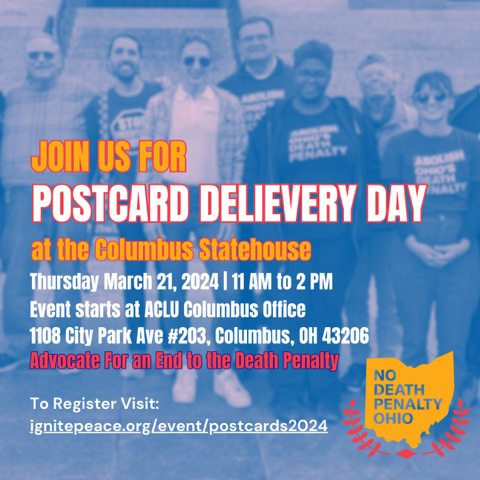
The quest to end the death penalty has bipartisan support and is a top priority of the Ohio Council of Churches this year. On Thursday, March 21, advocates are meeting at the ACLU Columbus office, 1108 City Park Avenue #203, at 11 a.m. and will deliver 1,500 handwritten postcards to Ohio legislators. Register here. “We’ll start the day getting to know one another better at the ACLU office, get a small training on how to deliver the cards, enjoy a provided lunch and then head to the statehouse together to deliver the postcards,” writes No Death Penalty Coalition member Bekky Baker, MSW, Program Director of Ignite Peace in Cincinnati. “There will be a few visitor spots open in the ACLU parking lot and there is free street parking on the surrounding streets – City Park Ave, Mithoff St., Thurman Ave.”
Grassroots child care advocacy group includes Ohioans
The Ohio Capital Journal reported last week that a new nationwide grassroots movement to increase the supply, quality, and affordability of child care has led to the formation of a nonprofit called the Campaign for Childcare. If you’re struggling to afford childcare or helping young parents, take a look at their advocacy points on increasing supply, infrastructure, child care provider wages, and child care subsidies for working families.
In Ohio, working parents are struggling because of a drastic decline in the number of childcare workers, a critical shortage of child care centers – especially in Appalachian Ohio – and the fact that Ohio restricts eligibility for child care subsidies to extremely low-income families. In addition, the state reimburses chlid care workers at a rate below 65% of what providers in their area are charging.
All of these factors have raised the cost of child care to unsustainable levels: “The average monthly cost for one infant’s care eats up almost 17% of the typical (median) household monthly income. The U.S. Department of Health and Human Services says child care is unaffordable if it costs more than 7% of a family’s income. According to the Economic Policy Institute, that means child care is only affordable for the highest-paid 12.2% of Ohio households.” says Policy Matters analyst Kathryn Poe. Thus, she recommends advocating that state legislators increase reimbursement rates for child care workers and raise the income eligible for child care subsidies.
In an interview March 4, Ohio Chamber of Commerce President and CEO Steve Stivers cited the child care crisis as a huge constraint on workers ability to be able to participate in Ohio’s rapidly-expanding job market, citing the same issues: the child care desert in rural areas and the enormous cost of child care, in many cases higher than rent. The Chamber is seeking a state legislator to introduce a bill to address these challenges. I’ll keep you posted.

Advocacy briefings are compiled by Ariel Miller, a longtime community advocate and member of Ascension & Holy Trinity, Wyoming. Connect with her at arielmillerwriter@gmail.com.
