
Bearing Witness
The last ten days have been filled with appalling violence against civilians in Israel and Gaza and beyond, including the knife attack by an Illinois landlord on a Palestinian family who were his tenants, killing a six-year-old boy and gravely wounding his mother. Here’s the Episcopal Church link to advocacy by Churches for Middle East Peace, as well as the Episcopal Diocese of Jerusalem.
Several times a year, we renew Baptismal vows to seek and serve Christ in all persons, to our neighbors as ourselves, to strive for justice and peace among all people, and to respect the dignity of every human being. I think that living out these vows is one of the biggest contributions our faith community can make to our increasingly fearful and violent society.
This week’s post includes links to essays on Nobel Laureate Claudia Goldin’s research on the economic benefits of family planning, and Episcopal Bishop Gene Robinson’s just-awarded honorary doctorate from Sewanee. These honors resound against the backdrop of anti-LGBTQIA+ bills in our legislature and the battle over reproductive rights (Issue 1). The honors illustrate the blessing of welcoming and encouraging people whose potential is too often stunted by neglect, hatred, and violence.
Oct. 19 Ohio Moms Demand Action briefing on Ohio’s Second Amendment Protection Act. 8-9 pm on Zoom
Ohio Sub HB 51is advancing in the Ohio House and would expose Ohio local law enforcement to $50,000 fines and lawsuits for enforcing federal gun laws. Register here to get the Zoom link. Here’s an overview of the bill by attorney Steve Calardo, a member of the Ohio Moms legislative team. This link gives the names and contact information for the Ohio House Government Oversight Committee.
Nov. 7: Episcopal Church offers Virtual Advocacy Training for LBGTQIA2S+ Advocacy Days, 1-4 pm
The Episcopal Church’s Office of Government Relations is providing training for advocates for federal protections for people of all sexual orientations and gender identities and expressions. Participants will hear from Office of Government Relations staff, network with other Episcopalians, and connect with key coalition partners in the LGBTQIA2S+ advocacy space. Register here.
Following the training, participants will have a chance to connect with their members of Congress to push for the Equality Act, a bill that The Episcopal Church has endorsed and advocated for. While the focus will be on meaningful federal legislation, guest speakers will also share information about key advocacy at the state level and opportunities to connect with them.
Participants will receive guidance on setting up virtual meetings with their members of Congress and/or in-district meetings with local staff. Advocacy meetings for this option do not necessarily need to take place on the same day and may extend into the following week.
Issue 1 would guarantee Ohioans’ right to family planning
Early voting has begun on Issue 1, accompanied by a barrage of ads against and for its protection of abortion rights. The ballot language only briefly notes that the amendment would also protect the right to contraception, which we used to call “family planning.” Last week American economist Claudia Golden won the Nobel Prize for her work on women’s labor market participation and its benefits. One factor she researched was the impact of the birth control pill freeing women to plan when to have children, allowing them to pursue education and to balance child-rearing with careers.
“Sometimes a new technology changes everything — the way we work, the way we live, the way we relate to one another in society. Consider, for example, the effects of the birth control pill,” wrote fellow Nobel Laureate Paul Krugman last week. “If it never occurred to you that modern birth control was a transformative technology, or more broadly that expanding women’s ability to choose had profound economic as well as social effects, you have plenty of company. There have been innumerable books and articles about the economic impacts of, for example, globalization and information technology.
“But in 2002, when Claudia Goldin and Lawrence F. Katz published an article titled “The Power of the Pill: Oral Contraceptives and Women’s Career and Marriage Decisions,” they were entering a sparsely populated field. On Monday, Goldin, a professor at Harvard, received the Nobel Memorial Prize in Economic Sciences in recognition of her role in advancing our understanding of women’s labor market outcomes. It was a richly deserved honor.”
“In fact, if you ask me,” Krugman continues, “the Nobel announcement sold Goldin a bit short by failing to note her hugely important contributions beyond the issue of women’s work. In particular, it didn’t mention her work on inequality more broadly, notably her role in documenting the sudden and drastic decline in inequality that took place in the 1940s, creating the middle-class society I grew up in (which has now been destroyed).”
Training to promote voter turnout
Ohio’s November 2023 elections will determine many crucial statewide and local outcomes including reproductive rights, city council and school board members, local charter amendments and tax levies. Visit the website of your county Board of Elections to see the candidates and issues that will appear on your ballot.
The Episcopal Church offers election activator training for people who want to promote voter turnout in the next national election, 2024, in which the President, one of Ohio’s Senators, and all our members of the US House will stand for election. Apply here.
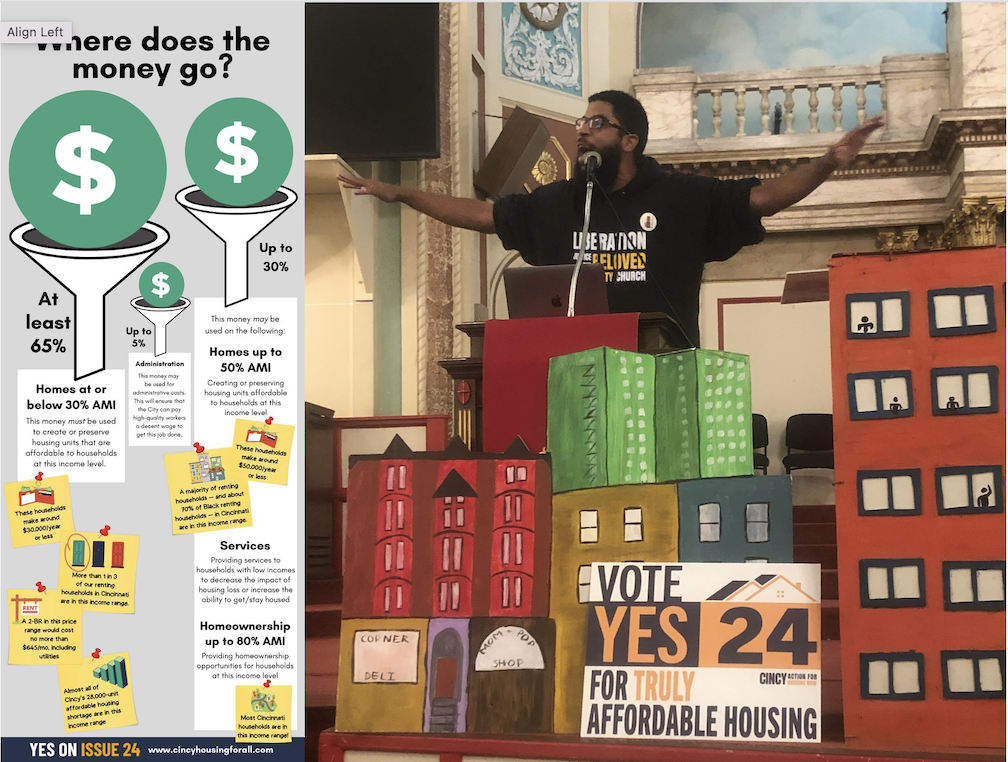
Cincinnatians weighing Issue 24 to fund affordable housing by restoring an earnings tax cut taken in 2020
Many Episcopalians (including me) have been canvassing for Issue 24, which is supported by the Cincinnati Homeless Coalition, ALCU, and Cincinnati Federation of Teachers, while several other leadership groups including Cincinnati’s Democratic Committee, Hamilton County Republican Party, the Chamber of Commerce, and the police and firefighters’ unions have come out against it.
Randy Tucker of the Cincinnati Enquirer published several insightful articles last week, explaining that at least 65% of the funds would go to developing and maintaining families earning less than 30% of the area median income – $30,350 for a family of four – and up to 30% for those earning up to 50% of the area median income. He also cited the prohibitive and rising costs of housing, and a Chamber of Commerce report that the median income of Cincinnati’s Black households is $37,659, compared to $76,337 for white households. Supporters say the earnings tax would cost the average household $11 a month and generate $40-$50 million a year. I have not yet been able to find out what Cincinnati City Council is proposing as an alternative plan to generate significant money to develop affordable housing, of which we have a dire shortage. Stay tuned, and please email me if you have information.
As many states debate and pass bills targeting LGBTQIA+ people, Sewanee grants honorary doctorate to Episcopal Bishop Gene Robinson
Almost 20 years after Sewanee alumnus Gene Robinson was elected Bishop of New Hampshire, and a decade after his retirement, the University of the South extended a recognition to him which is almost automatic for Sewanee grads who become bishops. This public recognition matters! Ohio is one of the many states debating bills that target equal rights for LGBTQ+ people. A number of our school districts are fighting over whether teachers can acknowledge and support students and families with varied sexual orientation.
Fellow Sewanee graduate Dr. Ben Huelskamp, Executive Director of the Ohio faith-based nonprofit LoveBoldly, published a poignant post Oct. 16 about the significance of Robinson’s honorary degree. “Speaking to the assembled congregation of board members, administrators, faculty, students, parents, and alumni, Gene gave a passionate and emotional oration on his journey of faith and his path to understanding himself and his call. With tears in his eyes, he admitted that ‘On many a night, I would walk through the dense Sewanee fog…out of which this chapel would magically appear, and I would get on my knees at [the] altar rail. God knew I had a secret, and God and I would fight about whether or not someone like me was worthy of seminary and ordination. My answer was ‘no,’ and God’s answer was ‘yes,’ and God won.’
“Yet again and from one of the most recognized LGBTQIA+ Christians in the world, we hear the struggle of feeling that one is unworthy and definitely not called to enter ministry or even to profess one’s faith because of what we have been taught is the place and end of people who are LGBTQIA+,” writes Ben.
The US House could pick our next president
In a New York Times editorial Oct. 14, “The Real Danger in Robert F. Kennedy’s Independent Run,” Jesse Wegman warns that the 12th Amendment specifies that if no presidential candidate wins a majority in the Electoral College, the election goes to the House of Representatives, where each state gets one vote. “North Dakota, whose single representative in Congress represents about 779,000 people, would have as much say in choosing the nation’s leader as California’s 52 House members, who together represent almost 40 million people. The two Dakotas combined (fewer than 1.7 million people, about the population of Phoenix) would wield twice as much power as Texas, with 30 million people. This is about as far from the principle of majority rule as you can get.” Wegman is the author of Let the People Pick the President: the Case for Abolishing the Electoral College

Advocacy briefings are compiled by Ariel Miller, a longtime community advocate and member of Ascension & Holy Trinity, Wyoming. Connect with her at arielmillerwriter@gmail.com
