
Ohio Legislature launches August election to raise bar for constitutional amendments
Once again, hundreds of Ohioans processed from Trinity Episcopal Church to the Statehouse May 10 to protest legislation to increase the hurdles to citizen-sponsored constitutional amendments, but the Ohio House passed SJR 2, the Senate speedily concurred, and it was adopted, including language calling for a special election Aug. 8 that is probably unconstitutional.
Within two days plaintiffs had filed a suit calling on the Ohio Supreme Court to block the election. Nevertheless, hundreds of civic and faith-based groups that oppose the changes in Ohio’s constitution are already working to mobilize voters in case it takes place. My goal in bringing this to your attention is to support democratic participation. It’s important for all voters who are affected by and care about this matter to be informed in time to cast their votes, whether for or against the constitutional amendment.
Here are two resources:
- Fair Districts Ohio Zoom briefing Wednesday May 17, 6 p.m.: Speakers including Mia Lewis of Common Cause Ohio and Jen Miller of the League of Women Voters Ohio, explaining how to get involved in the “No in August” campaign. Register here.
- Tool to send a letter to the editor: Ohio Citizen Action has set up an action page that makes it easy to write a letter to the editor with your own thoughts about the special election and higher hurdles to amend our constitution. It will send your letter to editors of the papers in your community. She points out that the special election (if it happens) is just 60 days from now. Most people don’t know it’s happening, and they may not know what’s at stake. Informing your community is really vital.
What’s at stake: Dramatic events in 2022 – the US Supreme Court ruling to overturn Roe v Wade and the failure of Ohio’s voter-adopted measures to prevent unconstitutional partisan gerrymandering in Ohio – have inspired campaigns to protect reproductive rights in the Ohio constitution and to remove redistricting from the control of elected officials, since whatever party is in the majority has a built-in conflict of interest in preserving their power. Supporters say raising the bar is to protect our constitution from out-of-state special interests, but the Columbus Dispatch reports that Illinois billionaire Richard Uihlein has donated over $1 million to the Save Our Constitution PAC to pay for ads championing the higher hurdles to citizen-sponsored amendments.
Ohio’s legislative leaders have been trying since December to pass a resolution to make it harder for citizen-sponsored constitutional amendments to qualify for the ballot, and then to require such an amendment to pass by 60% of the votes cast, instead of the simple majority that has been part of the Ohio Constitution for over a century. This constitutional amendment has to be approved by voters to go into effect. The resolution -SJR2/HJR1- missed the deadline for the May primary ballot.
In December, the General Assembly had just passed a law banning statewide August special elections because of the expense and low turnout. Because this new law is on the books, the sponsors of the stiffer amendment requirements tried to pass a bill to set up a special election Aug. 8 to try to get the higher hurdles into the constitution before any vote on the reproductive rights amendment, which could be on the ballot in November. Ironically, a simple majority of the typically anemic turnout for August special elections would be sufficient to put these new rules into our Constitution. This bill failed to advance out of committee last week, so the supporters of SJR2 tacked on the language setting up the August special election in the resolution that passed.
All four living former Ohio Governors, plus five former Attorneys-General and the board of state election officials, have spoken out in opposition to the special election and making it harder for citizens to amend our constitution. It’s also notable that five Republican members of the Ohio House voted against SJR2: Reps. Jamie Callender, Jay Edwards (House Finance Chair, from Athens), Brett Hillyer, Jeffrey LaRe, and Tom Patton. The Save Our Constitution PAC paid for radio ads this spring attacking Edwards and House Speaker Jason Stephens, a fellow Southeast Ohio Republican, who was reluctant to try for the special election. See more interesting news about Rep. Edwards in my update on the state budget, below.
Legislators express appreciation for bipartisan collaboration on the Ohio House’s budget bill
In striking contrast to the fights over the US debt ceiling, some Ohio House members spoke publicly about parts of the House-passed budget bill that they find especially rewarding, expressing respect for colleagues on the other side of the aisle. One example is the Cincinnati Edition interview with Reps. Cindy Abrams (R) and Dani Issacsohn (D), both expressing support for K-12 public schools.
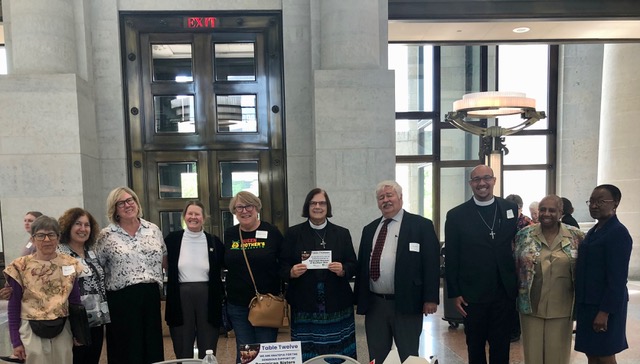
While attending the Hunger Network’s “Our Daily Bread” luncheon at the Statehouse May 11, Episcopalians from seven congregations witnessed mutual courtesy (without glossing over policy differences) between the two people who will represent the Ohio House in conference committee negotiations to finalize the budget: House Finance Committee Chair Jay Edwards (R-Athens) and Ranking Member Rose Bride Sweeney (D-Cleveland). They will be defending the House’s proposals to increase funding for K-12 public schools, as well as the House plan to send $30 million more to Ohio’s foodbanks over the next two fiscal years.
I got to sit next to a staffer for Rep. Jaime Callender (R-Columbus), who explained that Callender co-sponsored the Fair School Funding Formula launched two years ago, supports the House’s raising the base per-pupil cost for calculating state aid to local districts, and supports the increased hunger funding. The Senate is likely to strip both out of their version of the budget. Callender’s aide told me fiercely “we’ll get it back in conference committee!” Callender’s bio on the Ohio Legislature website lists credentials including awards from the NRA and as a fiscal conservative. Celeste Parsons of Epiphany, Nelsonville was listening attentively as Edwards shared his sister’s perspective as a public school teacher in the Hocking Valley on child poverty and the need for good nutrition and schools.
The Ohio Senate is already immersed in hearings on the state budget
Big issues include:
- whether or not they will cut back emergency food funding,
- cut the per-pupil base cost back to 2018 levels,
- further cut income taxes, and
- fulfill Senate President Matt Huffman’s goal to offer vouchers to any student in Ohio in private, charter or home-schooling.
On vouchers, we’re hearing from several sources that voucher expansion is probably inevitable, but that House members will demand accountability for that taxpayer money, including requiring test results and fiscal reporting from these schools. Allies in this effort include Senator Lou Blessing, a Republican from northwest Hamilton County. Blessing also has a proposal to reduce the cost of vouchers by means-testing: that the size of the scholarship would be progressively reduced at family incomes above the current limit, 250%. Senate President Huffman is open to this idea.
Contact your Senator this week with your views on emergency food and K-12 funding, including public schools and vouchers. You can find your Senator’s contact information by going to the Ohio Legislature home page and putting your address in the box “Who Represents Me.”
How to aid asylum seekers coming to or through your town
Nancy Sullivan of Church of Our Saviour writes today about several ways you can help asylum applicants – most with children – traveling to reunite with relatives or other sponsors. The Associated Press reports that the number of migrants at the US-Mexico border dropped 50% after the pandemic-area Title 42 restrictions ended May 11. The article cites immigrants’ anxiety over new asylum rules as a factor in a surge of people before the new policies went into effect.
“These are families who may have waited up to several years under very dangerous and traumatic conditions at the border. Often their families here have very limited resources to help them get on their feet,” reports Sullivan, who leads Our Saviour’s Transformations ministry with the immigrant community in Cincinnati. “ If they are traveling on to another destination by bus, they are too often cold, hungry and lacking basics like diapers. Members of the incredible local group Cincinnati Immigrant Transit Assistance meet these buses with food, light blankets, personal products and encouragement. Consider joining them via their Facebook group.
“Another fantastic Cincinnati group, Heartfelt Tidbits, is already putting some of these families up in motels when they have nowhere else to go- Cincinnati-area homeless shelters are completely full.
Transformations CDC is helping families with the resources they need, from diapers to transportation or getting medical appointments for new arrivals with serious medical issues.
“Can you volunteer to help drive one person to ICE or a medical appointment? Or meet one bus a week?
Can your civic group or religious congregation host a diaper drive, solicit (and transport) beds? What about gently-used children’s clothing? Please message me via the Transformations CDC Facebook page.
It takes a village to welcome and sustain these asylum-seekers, especially the children.”
Solar United Neighbors Webinar on how to advocate for community solar
A bipartisan bill to allow community solar projects in Ohio died in committee last year, but advocates are trying again. Community solar would allow Ohioans including tenants to buy electricity generated by a community solar project not on their homes or buildings – say, on the grounds of a church or community center.
Solar United Neighbors is a Community Solar Town Hall Meeting on Zoom to explain how community solar works, new legislation being planned, and how to engage legislators. Register here for a webinar May 17 at 6:30 p.m. They also invite you to join a Community Solar Action Team in your part of the state.

Advocacy briefings are compiled by Ariel Miller, a longtime community advocate and member of Ascension & Holy Trinity, Wyoming. Connect with her at arielmillerwriter@gmail.com
