
EquaSion Panel on Christian Nationalism
Thursday, May 25, 7 p.m. at Christ Church Cathedral
This live event, moderated by Dr. Marlaina Leppert-Wahl of Wilmington College, presents University of Dayton history professor Dr. William Trollinger, Ohio Council of Churches Executive Director Rev. Dr. Jack Sullivan, Jr. and Rabbi Gary P. Zola, PhD, Executive Director of the American Jewish Archives at Hebrew Union College in Cincinnati. EquaSion is an interfaith coalition working for racial justice in Cincinnati. The Very Rev. Owen Thompson, Dean of the Cathedral, will give opening remarks.
Informing and Equipping Voters for the August 8 Special election
On May 10, the Ohio Legislature passed SJR 2 to make it significantly harder for citizens to qualify a constitutional amendment for the ballot, and also increase the threshold for passage from a simple majority of voters to 60%. Because SJR 2 is itself a constitutional amendment, it has to be approved by voters to go into effect.
The resolution calls for a special election August 8, which violates a law – HB 458 – passed by the Legislature less than six months ago to prohibit statewide special elections in August because of their high cost and low turnout. By May 12, citizens had filed a lawsuit asking the Ohio Supreme Court to block this election because the law prohibiting it is still in effect (see more on this, below)
Because of huge implications of this election for citizen voice in Ohio, and because the Legislature has also passed significant changes in voting rules, this post offers resources for voter education and protection. This is crucial for every eligible voter, no matter what their views on other proposed changes to Ohio’s constitution. Thanks to Janice Urbanik of St. Anne’s, West Chester, for sharing these resources.
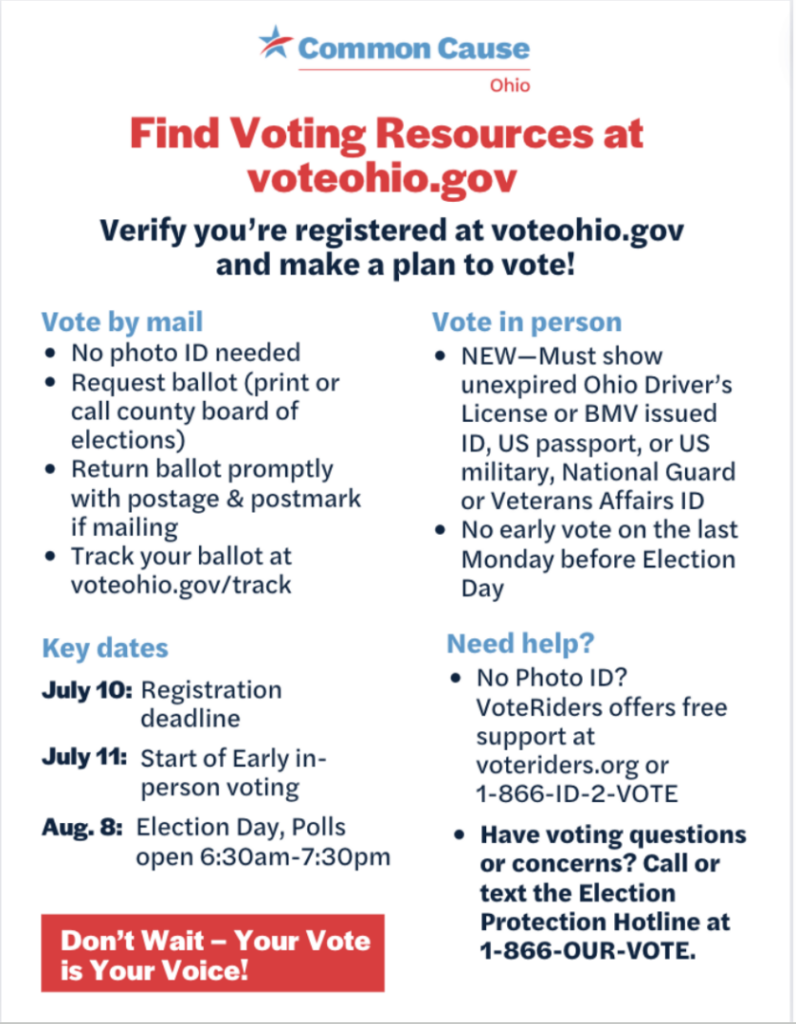
- The graphic from Common Cause Ohio summarizes the calendar and rules for registration and voting by mail or in-person, including new voter ID requirements. Use this link to request a Ohio Voter Education Team presentation. You can also sign up for the June 23 webinar to be trained to serve on the OVET Speakers Bureau yourself.
- Ohio Citizen Action has set up an action page that makes it easy to write a letter to the editor with your own thoughts about the special election and higher hurdles to amend our constitution. It will send your letter to editors of the papers in your community.
- Sign up to be a poll worker in August. Boards of election are facing major challenges in retaining and recruiting enough people after the enormous stresses of the pandemic, distrust and threats against election officials, and last summer’s special election, which drew less than 8% of eligible voters but still required all the work.
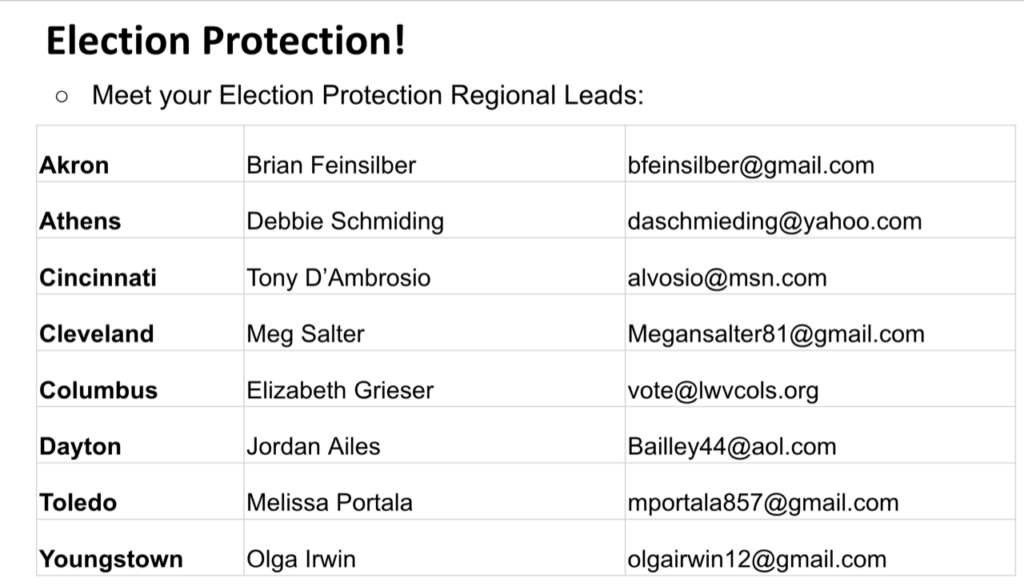
- You can also help by signing up as an election protection volunteer or Election Ambassador. The chart with this post gives the contact information for the Ohio Voter Rights Coalition’s election protection leads in eight cities, including Athens, Cincinnati, Columbus, and Dayton.
- If you oppose the special election and the higher hurdles for amending Ohio’s constitution, you can request fliers and other materials from the One Person, One Vote campaign of Common Cause. Here is the link.
What’s at stake: Over the past forty years, Ohio voters have passed constitutional amendments on issues including funding for public infrastructure, school construction, and affordable housing. Many passed by margins below 60%. Under our Constitution, Ohio voters have had the right to amend the Ohio Constitution with a simple majority vote for more than a century.
The rush to pass SJR 2 in August comes as people are circulating a petition to place a reproductive rights amendment before Ohio voters in November. “Republicans have admitted this effort is largely to stop abortion from becoming legal,” writes Morgan Trau in the Ohio Capital Journal. “[Ohio League of Women Voters Ohio President Jen] Miller says it does so much more, including diminishing a voter’s choice on issues like redistricting, worker laws and bonds — like funding for bridges. ‘They are taking away our rights as voters or they’re attempting to do so during an election that many Ohioans won’t even know is happening,’ Miller added.”
Citizen groups are working to place other proposed amendments on the ballot in 2024, including another attempt to rein in partisan gerrymandering after the Ohio Redistricting Commission defied rulings by the Ohio Supreme Court in 2021-22 finding each of the seven maps they adopted violated the Ohio Constitution by giving an unfair advantage to the majority party. Our primaries and general election since then have been conducted using unconstitutional district maps.
As I reported earlier this month, members of both parties including all four of Ohio’s former living governors and five of the former Attorneys-General, plus the board of the statewide election officials association, oppose SJR 2 and the special election, as do hundreds of civic groups.
All briefs in the lawsuit challenging the legality of the August special election had to be submitted by May 22. The Ohio Supreme Court will decide on the basis of these briefs, without oral arguments, due to the urgency of the matter. In the meantime, advocates are working to help voters register or update their registration by July 10 and to educate them on the importance of this special election and how to succeed in casting their vote.
Ask your State Senator to include $5 million for gun violence prevention in the State budget bill
“Everytown research shows that organizations working to prevent and diminish gun violence are effective,” writes the Ohio Chapter of Moms Demand Action for Gun Sense. “The Ohio Senate is now considering HB33 and we need to impress upon members how important this is. Please ask your state senator and those on the Health Committee to amend this budget to include $5 million funding for violence prevention programs across our state.”
I recommend that you read Statehouse reporter Anna Staver’s deep exploration of the cultural and political dynamics that fueled a complete transformation in Ohio’s gun laws over the past 20 years. The story was published this week in the Columbus Dispatch and on the front page of the Cincinnati Enquirer. She starts with 2004 when the Legislature removed a ban on concealed weapons which had been in Ohio law since 1859. The article includes a timeline and a graph showing a sharp rise in assault rifle sales after the federal ban expired and the US invasions of Iraq and Afghanistan enabled gun manufacturers to market assault rifles as symbols of American prowess. She also links to a 2021 study by the American Academy of Pediatrics showing a correlation between gun sales and deaths of children under 12 in their homes during the pandemic.
Gun deaths including accidental shooting and suicide are now the leading cause of death for American children, but the Ohio Senate passed SB 58 in April forbidding local jurisdictions from requiring liability insurance of gun owners. The House Insurance Committee held its first hearing on the bill May 10. The Ohio Legislature has continued to loosen restrictions on guns, even after the mass shooting in Dayton. These include a Stand Your Ground law providing a defense for people who shoot others in public, allowing conceal-carry without training or a permit, and reducing the required training for armed teachers and school staff from over 700 hours to less than 30.
Contact Senate Finance Committee on State Budget
HB 33, Ohio’s next biennial budget as passed by the House, is now in hearings in the Senate Finance Committee. Episcopalians from many congregations are anxiously watching the line items for public schools, the Senate President’s priority of making every private or home-schooled student eligible for vouchers, and funding for Ohio’s foodbanks. I encourage you to talk to school officials, people providing emergency food, and others to get first-hand testimony to send to Senate Finance Committee Chair Matt Dolan. The Rev. Nick Bates, Executive Director of the Hunger Network in Ohio, recommends hand-written notes. Here’s the address:
Senator Matt Dolan, 1 Capitol Square, Room 127, Columbus, OH 43215
You can also email Senator Dolan.
Explain that you are a person of faith, why the budget is important to you as a moral document, share a first-hand story of why the policy is important, and ask him to support it. Among the policies you could advocate for:
- Increasing funding for Ohio’s foodbanks to $50 million a year because of inflation, the end of expanded pandemic SNAP benefits, and rising hunger. Ohio foodbanks, with their free or discount commodities, are crucial to our pantries and community meal programs. The Governor proposed $25 million. The House budget set it at $40 million a year.
- Supporting the House commitment to implement Ohio’s Fair Funding Formula for K-12 public schools.
- If the Senate expands eligibility for vouchers for private or home-schooled children, do this on a sliding scale, with vouchers declining as income rises above 250% of the poverty level.
- Require that private schools receiving these vouchers have the same accountability to taxpayers as public schools, for reporting academic results and finances.
- Ask the committee to add $5 million for gun violence prevention (see article, above).
Four Senators representing our diocese serve on the Senate Finance Committee:
- Senator Louis Blessing, III (R-Hamilton County)
- Senator Andrew Brenner (R-Delaware), who chairs the Senate’s Education Committee
- Senator Hearcel Craig (D-Columbus), and
- Senator George Lang (R-Butler County)
Senator Blessing is the person who came up with the proposal of the sliding scale for vouchers. As introduced, HB 11 (aka “the Backpack Bill) is a top priority of Senate President. The non-partisan Ohio Legislative Services Commission estimated it could cost taxpayers $1.13 billion a year if all of the more than 185,000 Ohio students who are in private or home school took the scholarship at its full current value – $5,500 for grades K-8 and $7,500 for high school.
Ohio Environmental Council statewide policy briefing
Ohio Environmental Council (OEC) is a statewide non-profit environmental law firm. On June 6, policy experts from the OEC Action Fund will report on issues they are tracking this year, including federal and state policies affecting environmental regulation, infrastructure improvements, and the health of our democracy. Register here for the 12 p.m. event. If you are not able to attend virtually on June 6 you can still register to receive a recording.

Advocacy briefings are compiled by Ariel Miller, a longtime community advocate and member of Ascension & Holy Trinity, Wyoming. Connect with her at arielmillerwriter@gmail.com
