
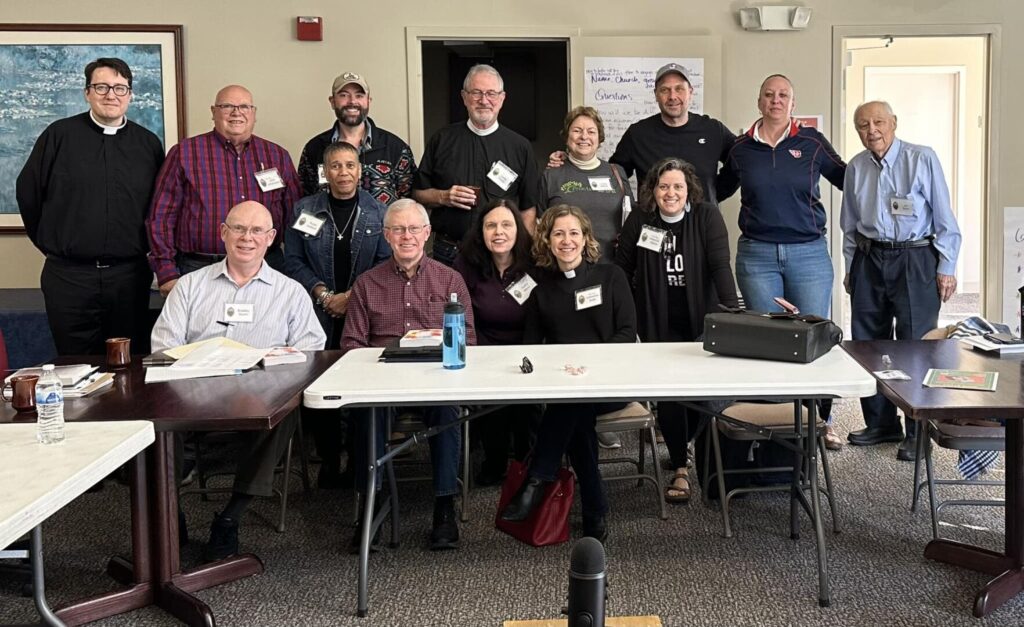
If you are the kind of person who attends diocesan meetings, you may have noticed that those meetings are being organized and facilitated differently in the last month or so. In mid-March, Bishop Kristin White held a one-day meeting for diocesan committee leaders and introduced them to the work of Priya Parker, author of “The Art of Gathering: How We Meet and Why it Matters.”
Parker’s book, a New York Times bestseller in 2018, offered five rules of gathering intended to make meetings more efficient productive, efficient and enjoyable, and to make people who attended feel as though their time had been well used and their concerns taken seriously.
The idea for the meeting had emerged from the Systemic Review Committee chaired by the Rev. Canon John Johanssen, who will retire as canon to the ordinary at the end of April.
“He suggested bringing leaders of various committees and commissions together and I want to honor him and give him credit for this idea,” White said. “Initially we were going to focus on people meeting me and hearing about leadership, but what became clear to me was we really needed to think about why we were gathering — Priya Parker’s point about every gathering having a purpose.
“My initial hope was to do two things. The first was to help people begin from that place of intention, rather than simply gathering to be in compliance with rules and bylaws. It’s not that I don’t not value those things, but underneath that, we have work to do together in coming together to build the body of Christ.
“The second was to help us realize that we meet with care and attention to the specific work before the various bodies,” the bishop said. “Knowing our purpose for every meeting felt like a crucial starting point.”
Participants got an agenda a week ahead of time, began the meeting with prayer and introductions, and explained why their committees existed and what essential purpose they served. Then they were asked to discuss one meeting they were particularly glad they attended.
“The meeting was a couple of different things at the same time,” said the Rev. Catherine Duffy, deacon at St. John’s Worthington, who co-chairs the Creation Care and Environmental Justice Commission. “We were talking about running a meeting well while having the experience of being in a well-run meeting.
“And I think the people who were in the room really wanted to be there. We want these skills. We want these relationships. We want to know our work maters to the life of the diocese. This gathering really communicated that,” she said.
Attendees received a copy of Parker’s book, which includes five rules for a successful gathering of any kind, whether it is a committee meeting or a family reunion: give your gathering a purpose; let the purpose of the meeting determine who needs to be present; design a persuasive invitation; establish “pop up rules,” such as no cell phones allowed to focus participants on the purpose of the gathering; close the meeting with intention.
White also shared the Group and Team Dynamics Model from the College for Congregational Development. This model invites leaders and participants to attend to three elements needed for every group or team to be effective: the group’s task, maintenance of relationships, and members’ individual needs.
“I am fundamentally very practical,” the bishop said, “and I think that the church needs to be attentive to the actual work before us, that we need to honor people’s gifts and offerings with care by actually thinking through what we are trying to do. I want people to feel loved and make it clear we are paying attention to their time, that we are extending a level of generosity that includes attention to welcoming them in, and making sure they have what they need.”
Spencer Izor of St. Paul’s, Dayton, who serves on Diocesan Council and the Procter board, also served on the Systemic Review Committee that recommended the meeting. She was grateful the bishop responded positively to the suggestion. “Finally, we had a conversation about what it is we all do, and why we give our time,” she said. “I thought it was really encouraging of the bishop to use [the Parker] text as it relates to how we gather.
“After the pandemic, all of our churches are reexamining what their purpose is, what it is they are asking of their volunteers, and what those volunteers want from their church moving forward,” she said.
“We need to reimagine and reevaluate the way we do things and maybe even reinvent what church looks like for many people and that can begin with the way in which we gather in smaller settings as boards and committees.”
Izor said she had already attended a meeting at which Parker’s principles were employed, and Duffy said she had already drawn on the lessons of the session in organizing her own meetings.
“I think faithful leadership as disciples of Jesus isn’t rocket science,” White said. “I think it’s hard work. I want to equip people well for work that is essential for our communities and our world. So when I find resources that make sense, that will help us be more effective and more faithful, I want to put them in people’s hands.
“It’s not about discovering shiny new things; it’s about developing patterns consistent with who we are called to be and doing the work in ways that are trustworthy.”
image: Diocesan leaders gathered at Procter Center on March 16.
