
By Michelle French
As Episcopalians and Christians throughout the world engage with the Season of Creation, we are encouraged to reflect on how we can be at peace with creation. It is easy to feel overwhelmed when we think about all the ways our society and each of us is not at peace with our world, in fact, we regularly cause active harm. But in the midst of the discouragement when facing these overwhelming problems, there are always examples of people who are taking steps towards greater harmony with the earth and inspiring others to do the same.
We have two stories of different generations leading the way in their spheres of influence to better care for the earth. These stories highlight that anyone can take small actions towards better peace with the earth and can influence others to do the same.
The children at All Saints Episcopal Church in Pleasant Ridge in Cincinnati have been leading the way on recycling efforts in the parish. As part of a series, Children’s Ministry Director Julie Chaney taught the Junior Saints on creation care in May, the kids planted flowers for pollinators and created a recycling station for the parish hall, which until then had not had any convenient means of recycling. As any parent knows, if your child is interested in something, the whole family also becomes an expert on the topic! Growing enthusiasm among the children was a strategic way of engaging the whole congregation.
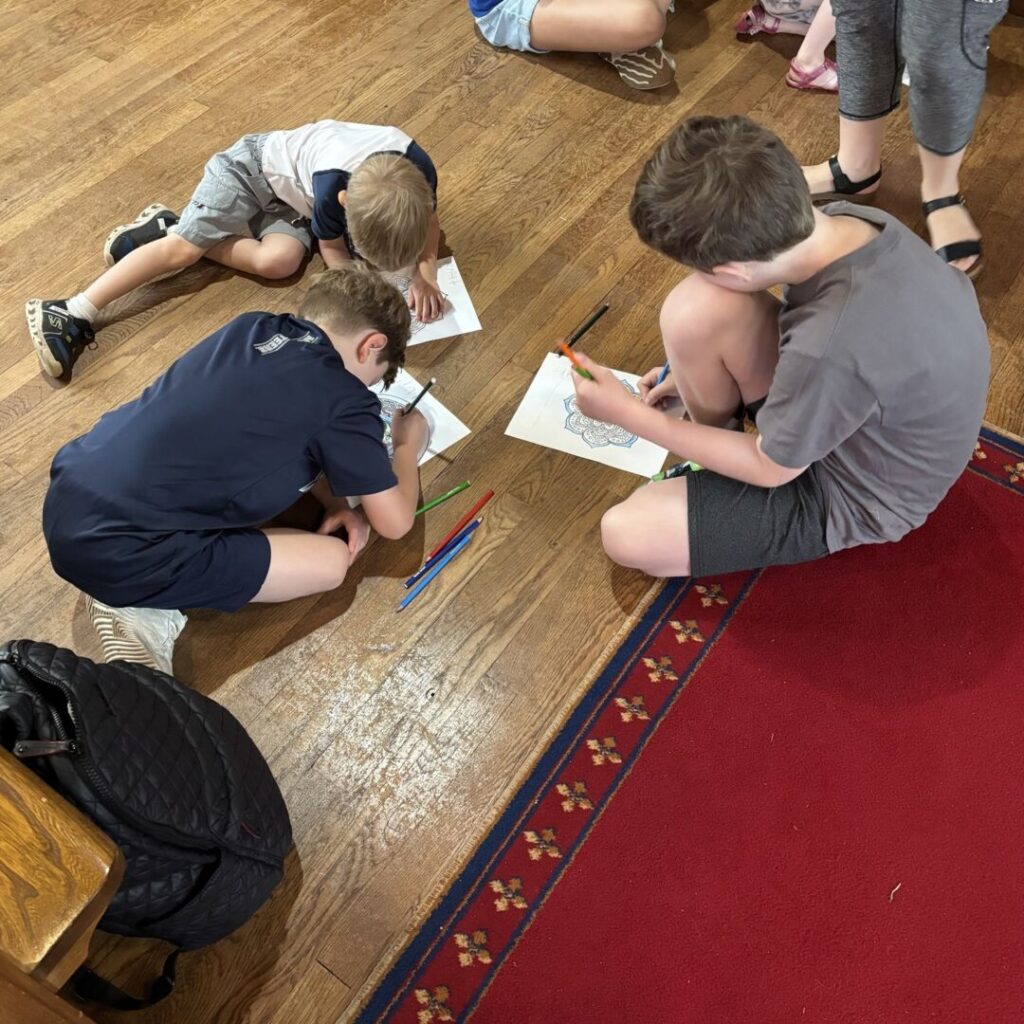
The kids were given four poster boards, plenty of tape, and a pile of what looked like trash – things commonly found around the church. Each poster board was for a different bin: curbside recycling, compost, trash, and the Hefty ReNew Program, an super-convenient expansion to curbside recycling that includes many hard-to-recycle items (you can read about this program and see if it’s available in your market here.)
The kids attached the trash to the appropriate board to make a very educational and “trashy” display as a guide.
Adults have responded favorably, saying it actually has been very helpful to have a concrete visual of what exactly can be recycled and how. The system has needed weekly checks after Sunday mornings to make sure things were put in the right bin. Luckily, there are members just crazy enough to sort through people’s trash and to take home the compost weekly to their own compost systems.
It’s been several months since the kids learned about creation care, but we were delighted to learn that the lesson stuck when they were interviewed for this story. Caroline, who just turned 7, explained, “I think God likes it [when we recycle] cause it’s his creation and he doesn’t want us to mess it up.”
She recalled imagining that she had colored a beautiful picture and given it to someone, and how she would feel if the recipient threw it on the ground and stomped on it. We talked about how that might be how God feels when we treat his creation with disdain, and not with the care and love it deserves.
At the other end of the age spectrum, at a senior living community in Cincinnati, recycling efforts had been limited to curbside recycling until some residents stepped up this spring to expand it.
A retired teacher, avid recycler, and long-term volunteer at the Cincinnati Recycling and Reuse Hub, Nancy Henry moved into the community in February. Since her bio mentioned recycling volunteer work, she was quickly approached by another resident about restarting the dormant Recycling Committee. Of course she agreed, and they recruited several other residents to join them. They started by assigning “Floor Captains” who regularly look through the trash closets on their floors to pull out obvious recycling. This thankless and not-glamorous task has already diverted a very large number of recyclables out of the landfill.
Nancy has volunteered at the Cincinnati Recycle and Reuse Hub since soon after they opened in April of 2021. This non-profit specializes in recycling hard-to-recycle items as a one-stop-shop. She suggested to the committee that they create a small recycling center to collect things to be taken to the Hub. The idea was met with great enthusiasm and the “Mini-Hub” was born.
She said the response among residents has been quite positive. “Many residents have told me that this is important so their grandchildren have a world to live in. I don’t have any grandchildren, but I know how vital it is.” Other people, she said, initially said they were not interested in the effort, but later came to her with questions to make sure they were doing it right! This response is most interesting—it tells us that many people are willing to take steps towards sustainability when other people lead the way, and make it easy.
So far, it’s taken a lot of hands-on work by Nancy. She checks the bins every couple days to re-sort anything in the wrong category. She takes many large bags, mostly filled with Styrofoam, to the Hub every week. She’s been training several other resident volunteers to do both of these things. Training others is perhaps the most important as it will ensure the work continues even without her and can expand beyond what one person is able to accomplish.
These two stories highlight some important things. Significant steps to making peace with creation can be made by entire organizations, but it only takes a small team of people to make it happen, and only one person to get that small group started.
As we saw from our kids, influence can come from even our smallest group members—and sometimes they can understand and communicate the reasons why better than anyone. Our seniors at Marjorie P Lee found many people are willing to care for God’s creation when it is convenient and explained to them. As the Season of Creation wraps up on October 4, consider how you might take a step as an individual to care for God’s creation, and then consider the places you go and if there are other people who would come along for the ride. After all, this is God’s creation, and he doesn’t want us to mess it up.
Michelle French is a member of All Saints Episcopal Church in the Pleasant Ridge neighborhood of Cincinnati and of the diocesan Commission on Creation Care and Environmental Justice.
