
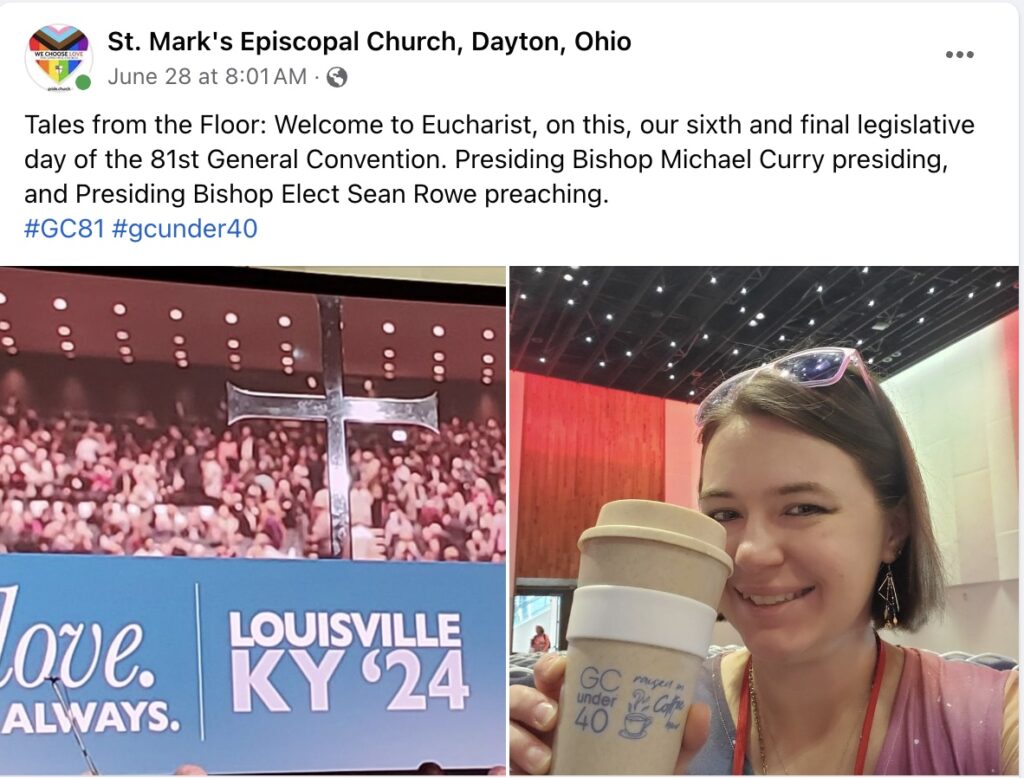
The Diocese of Southern Ohio had a number of well-known veterans like the Rev. Scott Gunn and Deborah Stokes-Wayne in its General Convention deputation. And several deputies had high-profile committee assignments, including the Rev. Lynn Carter-Edmands of the Committee on the Title IV Disciplinary Canons, the Rev. Gia Hayes-Martin on the Committee on Agencies and Boards and Harold Patrick on the House of Deputies Committee on the Confirmation of the Election of a Presiding Bishop. But first-time deputy Elizabeth Wagner-Weber, 29, made her own distinctive contribution with a steady stream of “Tales From the Floor,” a series of news updates posted on the Facebook page of St. Mark’s, Dayton.
“It was in the back of my head I wanted to try to post at least once a day,” says Wagner-Weber, who is an administrator of the parish’s Facebook page. “But it was very much going to depend on schedule.” As it turned out, she made many posts. Some were simply text, but others were videos, and the content ranged from news flashes to humorous items, to explanatory videos.
“The longest post I did was explaining a consent calendar and a legislative calendar,” she says. Scores of resolutions are resolved at General Convention without ever being discussed on the floor of either the House of Deputies or the House of Bishops. “I don’t think anyone back home knows this,” she says. “I tried to make it short and get the jargon out.”
Wagner-Weber, who is a laboratory technician at the Pace Analytical environmental water testing facility in Englewood, was also among the more visible members of the Young Adult Caucus, a fast-rising group of deputies under 40 whose activities ranged from endorsing candidates for the panoply of offices elected at convention, to testifying on legislation, to keeping an unofficial tally of more than 170 reported cases of COVID that broke out during and after the convention.
Wagner-Weber first became interested in the church’s legislative governance in high school when she attended a diocesan convention with friends from summer camp at Procter Center. “I was amazed at the debate, how polite everyone was and how they would attack an argument but not a person,” she says. “We had tried a debate in my high school English class, and it had dissolved into a screaming match. But there everybody was making such well-crafted arguments and being willing to work toward a compromise. I was hooked.”
After graduating from college, she went to the 2018 diocesan convention as a voting delegate from her church, and when she learned that the 2024 General Convention would be held in Louisville, a scant two-and-a-half-hour drive from Dayton, she put her name in nomination and was elected as a deputy.
At convention, she found the sheer volume of resolutions — there were 396 of them —overwhelming at first. “I am used to seven being a lot,” she says. But the Southern Ohio deputation supported each other well, eating lunch together every day and meeting frequently with Bishop White, and veteran deputies like Gunn and Stokes were “very happy to answer questions,” Wagner-Weber says.
She was especially glad to learn that there are enough young deputies churchwide for the Under 40 caucus to be both a political force and a supportive community at General Convention. “It was amazing to find friends who were the same as me in terms of their experiences and interests,” Wagner-Weber says. “It kind of helped me to maintain my sanity.”
During a convention in which the church elected the Rt. Rev. Sean Rowe as its next presiding bishop, and re-elected Julia Ayala Harris, who defeated two other candidates, including her vice president, there were numerous emotional high points. But what stood out for Wagner-Weber were the few resolutions for which the two-minute timer used during most debates was turned off and efficiency “became secondary to human experience.”
She was referring to the joyful unanimous votes to approve the juncture of the Diocese of Eastern and Western Michigan, which will now be known as the Diocese of the Great Lakes; the reunification of the Dioceses of Eau Claire, Fond du Lac and Milwaukee as the Diocese of Wisconsin; and, especially, the designation of the Navajo Area Mission as the Missionary Diocese of Navajoland.
After the passage of a resolution that approved adding a commemoration for the children of Indigenous boarding schools to the church calendar, three Indigenous deputies read from the dais A Prayer to Remember the Innocents, bringing tears to the eyes of many in the House of Deputies.
“It was very necessary for everybody to hear it because we need to know how much of reality it still is,” Wagner-Weber says.
Wagner-Weber says that she felt she was carrying on the legacy of her maternal grandmother, an active Episcopalian who was in her 40s before women were allowed to serve as deputies. “I am much younger than she was, and every door is open to me. Being able to go where she couldn’t was very important to my mother [Katherine Wagner, who is active at St. Mark’s] and me.”
And now that the door is open, she’d like to walk through it again. Wagner-Weber was excited to vote in favor of putting rites to bless same-sex marriages in the Book of Common Prayer and to change the catechism to say that marriage is between “two people” rather than between “a man and a woman.” But the resolutions have to be passed at two consecutive conventions to take hold.
“I really want to try to see that all the way through,” she says. “And I’m eager to go back and not be so lost those first couple of days.”
image: Wagner-Weber in a Tales from the Floor post on the St. Mark’s, Dayton Facebook page
