
by the Rev. Karl Stevens
An old joke asks how many Episcopalians it takes to change a light bulb. The punchline is that it takes one person to change the bulb and another person to say “My grandmother gave that light bulb to the church, and how dare you change it!”
We get invested in our buildings and in all the different objects that we and the people we love provided for the use of the community. We get comfortable worshiping in a certain place with certain things. If someone took the altar cross out of your parish’s sanctuary, you would notice. Imagine how it would feel if someone took the whole building.
Three of our four Historically Black Parishes (HBPs) have had their buildings taken from them in the course of their histories. They didn’t lose their buildings to fire or rivers overflowing their banks. The state took their buildings and demolished them in order to build the Interstate Highway System.
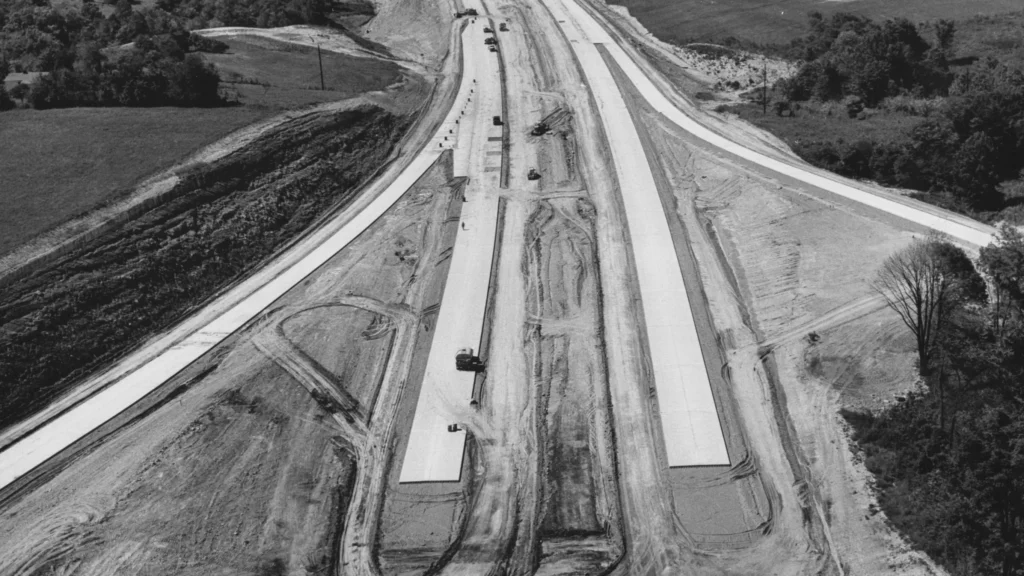
In Columbus, construction on I-70 began in the mid-1960s and cut a line through the Hanford Village Community, one of the few Black enclaves in the city. In the decades before highway construction, the neighborhood had struggled to build new housing, as they couldn’t find contractors and builders in Columbus. The building effort was deliberately sabotaged by White property holders and civic leaders. After years of struggle, out-of-town contractors were hired to build the new Carver Addition, a neighborhood of cape-cod-houses and curving streets. Twenty years later, highway construction leveled large parts of that neighborhood.[1]
Given this history of opposition to Black wealth and property, it is not surprising that Black neighborhoods turned inward and relied on certain key cultural institutions. Churches were among the bedrocks of these communities. In Columbus, Old St. Philip Episcopal Church had served the neighborhood since 1891. When the highway came through, it was demolished. A new site for the parish was found and a new building was constructed in 1962. The parishioners had to take out a mortgage to finish its construction. Following the Christian call to serve our neighbors, St. Philip thrived in its new location and again became a bedrock of the surrounding community. But their financial wealth was impacted in a way that is all too familiar to our Historically Black Parishes.
This same story repeated itself in Dayton and in Cincinnati. The timing was no accident. After the successes of the Civil Rights Era, federal courts were beginning to outlaw restrictive covenants, by which Black people were prevented from buying property in white neighborhoods, and the practice of “redlining,” which denied federally insured home loans to anyone living in a designated Black community. Schools and other civic institutions were becoming more integrated. White opposition to integration led directly to the decision to build highways through urban neighborhoods, which created concrete barriers between white and black neighborhoods that were as effective as any wall. [2]
Interstate highway construction is just one of many examples of the way that Black wealth has been plundered throughout our history. Ignoring centuries of proud history in various homeland countries, the Black experience in America starts with slavery, with stolen bodies and stolen labor. Continuing plunder kept Black people apart from major methods and institutions of wealth-building. When, despite the odds, Black people managed to accumulate wealth, it was taken by riots, by discriminatory laws, and by the seizure of Black owned property through eminent domain for so-called “public good.”
Does the church have a role in restoring Black wealth? There are undoubtedly some who will say, “it is shocking that wealth has been plundered from the Black community in this way, but how are we, as a diocese, directly responsible?”
Our entire faith is about taking responsibility for harms that we are not directly responsible for. The Kingdom of God is built on our willingness to do so. When we say the confession, we confess to things we have done and left undone, to our sins of commission and our sins of omission. When we help at a food shelf or a meal program at church, we are helping to address the imbalance of wealth that leaves some people impoverished. We do this because we take Jesus’s command that we love our neighbors as ourselves seriously. When we think of ourselves as the body of Christ, it is the health of the whole body that is at issue. If our Historically Black Parishes have had their wealth plundered by dishonest practices and government fiat, it is our responsibility to keep that reality always before us, and work, through our service and our advocacy, to redress it.
Our diocesan definition of reparations states:
For the Diocese of Southern Ohio, reparations is a discipline of repentance and repair following the way of Jesus, that reckons with historical and continuing wrongs against people based on their group identity. This requires a habit of assessing the harms we participate in, lamenting these offenses, changing our practices individual and institutional and surrendering substantial financial resources to heal what can be repaired and move toward mutual joy as beloved community which we undertake with God’s help. We will begin this work considering and addressing the harms against the Black community in this place.
For the past three years the Reparation Task Force has been working to define the scope of our reparations, our restoration of wealth to our Black siblings in Christ. There are many ways in which we can go about this, but in order to hold ourselves accountable we first need to be clear about the amount of Black wealth that has been stolen. Peter Jarrett-Schell, an Episcopal priest and author of Reparations: A Plan for Churches, created a formula for calculating this amount. All things being equal, one would expect a community to control an amount of wealth that is commensurate with their numbers in the overall population. Currently Black people represent 14.2% of the nation’s population (14.5% of Ohio’s population). So we would expect Black people to control 14.2% of the nation’s wealth, or about $17.6 trillion dollars. In actual fact, Black people control only about $3.35 trillion, about 14.25 trillion less than they would if they hadn’t been subjected to historical and ongoing plunder. In contrast, White people control about 80% of the nation’s wealth, or about $99 trillion dollars. The United State’s population is only 59.3% white. Something is clearly off.
As Jarrett-Schell writes, “Either we acknowledge that the Black community has been systematically plundered, and that that plunder deserves restitution, or we persist in the belief that there is something deficient about Black people. Squarely facing the reality of the wealth gap demands that we choose between an anti-racist and a white supremacist explanation. And it makes clear that there is no middle ground between them.”[3]
Given all of this, Jarrett-Schell calculates that churches should aim to use 14.7% of their wealth in reparations. This is a lofty goal, and it raises many questions. What counts as reparations? Which methods of wealth restoration will be most just and effective? What do we mean by “church” or “diocesan” wealth?
By diocesan wealth, we mean the funds and trusts held by the diocese, including The William Cooper Procter Fund and The Charlotte Elizabeth Procter Trust. We also consider the real estate value of 412 Sycamore Street and Procter Camp & Conference Center to be diocesan wealth. We do not mean income from parish assessments or parish property values. It is our hope that parishes will undertake their own reparation work, separate from that of the diocese.
Currently the diocese uses some of its wealth to engage in reparations work. We consider the Black Missioner position and the intentional commitment to Black leadership that the position represents to be a form of reparations. We consider the work of our task force and its very modest budget to be a form of reparations. We also include the Minority Empowerment Initiative Trust and the Lawrence Home Association Academic Grant for Minority Women. Some Becoming Beloved Community work counts as reparations, as does some diocesan sponsored advocacy work. Estimating the percent of its wealth that the diocese is currently paying in reparations is inexact, as we have only just embarked on the collective labor of achieving financial transparency. Our best estimate is that 1.5% of diocesan wealth is currently spent on reparations. We have a long way to go.
We know that the work of reparations is long and incremental. We will work at increasing the amount we spend on reparations year by year. We also know that there are many other communities that are in need within the diocese. It is our hope that our work will model a series of methods of caring for each other that can then be applied to the needs of all of our communities. As our reparations definition says, we start by addressing the harms against the Black community in this place because that community has suffered from the most egregious plunder over the longest period of time.
There are historical reasons for the wealth gap. There is also a clear call to us as Christians to make amends, to serve our siblings in Christ, and to make our way, day by day and grace by grace, into the Kingdom of God.
The Rev. Karl Stevens is rector of St. Stephens Episcopal Church in Columbus and co-chair of the Taskforce on Reparations for the Diocese of Southern Ohio.
[1] National Register of Historic Places, Hanford Village George Washington Carver Addition Historic Project, Columbus, Franklin County, Ohio National Register OMB 1024-0018
[2] Archer, Deborah N. “Transportation Policy and the Underdevelopment of Black Communities.” Journal of Affordable Housing & Community Development Law 30, no. 2 (2021): 253–80. https://www.jstor.org/stable/27305449.
[3] Jarrett-Schell, Peter, and Stephanie Spellers. 2023. Reparations : A Plan for Churches. New York: Church Publishing, 15-16.
