
Parishes experiment with hard conversations, celebration and commemoration.
By Nancy Bryan
Since the beginning of Advent, Episcopal congregations have been hearing readings from Year A of the Revised Common Lectionary, the three-year cycle of scripture readings used by many mainline Protestant and Roman Catholic churches. Di McCullough, a member of St. John’s, Worthington, and the diocese’s Faith In Life committee, is one of the people who has helped shape the way Episcopalians experience Year A.
As a contributor to “Planning for Rites and Rituals, Year A,” an all-in-one liturgical planner published by Church Publishing Incorporated that includes readings, worship, Christian formation, and hymn suggestions for each Sunday and holy day, McCullough has created liturgically based ideas for worship and education for all ages.
“My thinking is not ‘How can I hand something down,’ but ‘Who am I working with? What gifts do they already have, and how are they already part of what we’re already doing here?’” McCullough says.
She sees Planning for Rites and Rituals as a way to help Episcopal congregations that are “trying to bless the work of God in every day experience.” She defines that work as “formation,” a word that encompasses any number of easily identified programs such as Sunday School, youth ministry and adult education that form the faith of Christians over their lives.
“Formation is inclusive and shifts the question back to relationship,” McCullough says.
“I am not an example of all people my age, so it helps me to think ‘how do I make this accessible to specific children rather than to children as a category.’ We aren’t broadly accustomed to thinking intergenerationally in the church, but we can consider how we can create activities for and with the children and adults we are around. In a small parish, it is eas- ier to tailor to the specific individuals you know well but there is not a way to get around knowing our kids first,” she said.
Her approach is evident in congregations across Southern Ohio that are focusing on racial reconciliation in their formation efforts.
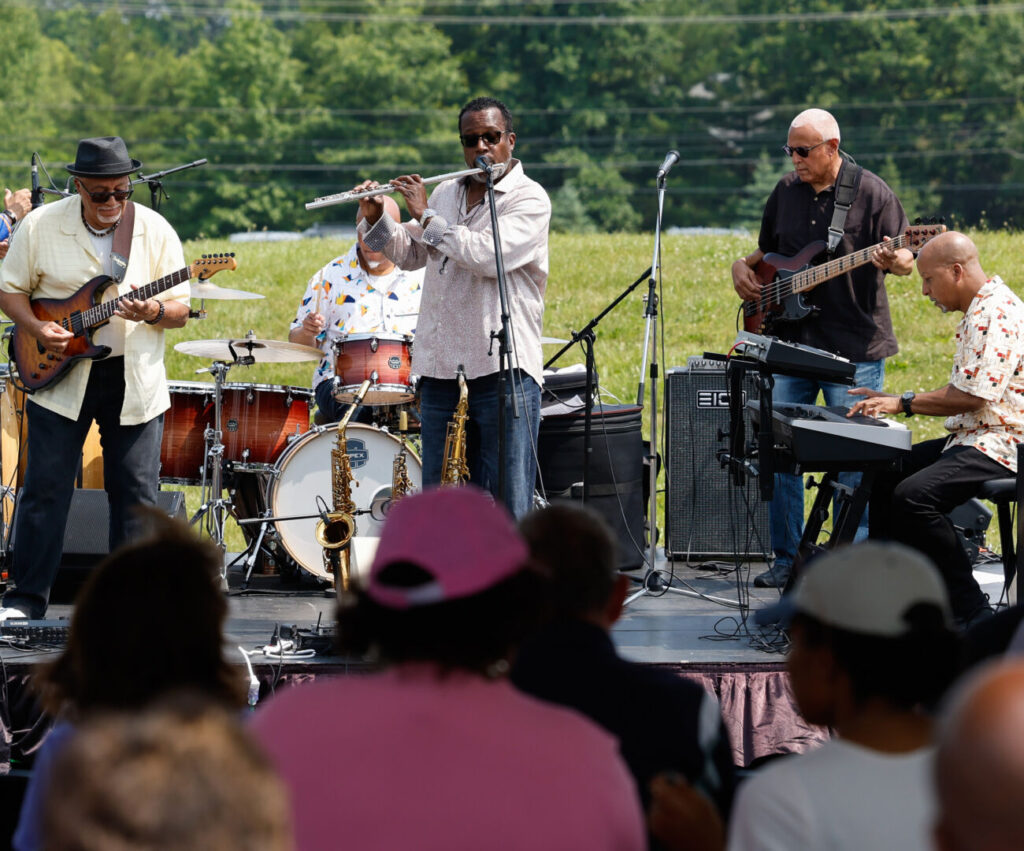
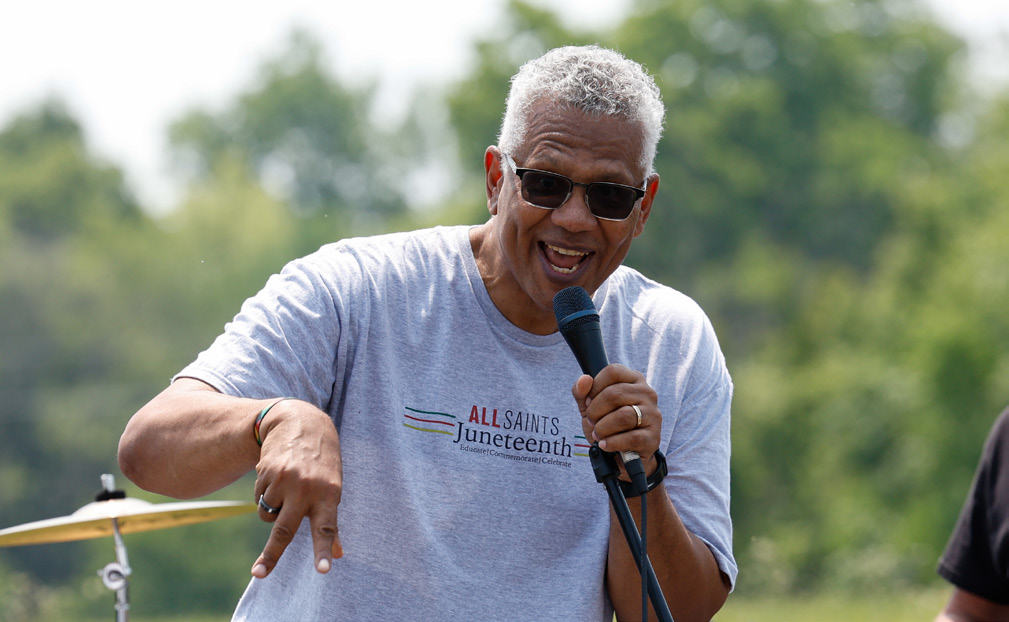
All Saints, New Albany was thinking intergenerationally when it planned a recent Juneteenth celebration. “I wanted to do more than celebrate Juneteenth,” says Gayland Trim, a lawyer who is doing his field placement at the parish and anticipating his diaconal ordination in the coming year. “This event needed to be about education, commemoration, and celebration: educating the church and the community, commemorate the event, and celebrate the marking of the end of slavery and a step along the way as civil rights work continues.”
Incorporating the kind of educational and formational concepts that McCullough espouses, Trim planned an afternoon of fun, interactive, and tasty events as members and neighbors of All Saints learned more about Juneteenth.
The day featured two bands, one the renowned Urban Jazz Coalition; Mexican, Nigerian, Ethiopian, and Creole food trucks; an appearance by children’s book author Dia Mixon; Juneteenth crafts; a children’s area featuring games and activities, and vendors offering a variety of handmade items.
“I want the congregation and community to have left the event changed and brought closer together,” Trim says. “‘I had fun, but I learned,’ is the best possible response. I’m not doing this for me and not necessarily for All Saints, but for the greater community to celebrate people’s heritage and culture and as a way to bring people together in love. This is another step toward loving and respecting each other.”
Trim believes racial barriers are broken down through proximity and conversation. To that end, All Saints, led by its rector, the Rev. Jason Prati, has been talking about race on Sunday mornings between its two services for the last three months, using “Waking Up White” by Deb- by Irving as the catalyst for the conversations. The parish is considering undertaking the Episcopal Church’s Sacred Ground curriculum, a video-based exploration of race and racism in American history.
St. Barnabas in Montgomery worked through the Sacred Ground curriculum training before the COVID pandemic took hold, and the parish’s Becoming Beloved Community Discovery, Discernment, and Action Committee was “looking for something meaningful for the congregation to get involved with BBC,” in the words of committee member Earline Fechter.
Adam Hayden, the diocese’s director of children, youth and young adult ministry, and the Rev. Canon Jane Gerdsen, the parish’s rector, pointed the group toward the Rev. Daniel Hughes, a Methodist pastor and community organizer with the Amos Project, an Ohio faith-based collaborative. In 2017, after an Ohio jury failed to convict a University of Cincinnati police officer in the fatal shooting of Sam DuBose, an unarmed Black man, Hughes and the Rev. Troy Bronsink, a Presbyterian minister, developed an eight-week program designed to create a context in which issues of racism could be safely discussed.
Meeting frequently with the committee, Hughes helped the group tailor a program to meet the congregation’s needs. It launched in the fall of 2022 with some 30 participants who met in a large single group before breaking into smaller groups, then reconvening over dinner. Every week, facilitators checked in with each participant to foster further reflection.
Bethanie Van Camp, a parishioner at St. Barnabas, said Hughes’ approach included foundational questions such as: “Who are you? Why are you here? What do you want from this experience? What are you feeling?” And Mark Stockman, another member of the congregation, said Hughes told the group, “‘We are the curriculum…’ The primary focus was on talking to each other.”
Earline Fechter, a member of St. Barnabas for almost a dozen years, said Courage to Connect had “helped make some conversations easier to have.” While for Van Camp, Courage to Connect involved “learning different layers and levels to myself—always reevaluating, going deeper.” After a pause, she added, “It’s being comfortable being uncomfortable.”
The Rev. Pierce Leavell, chair of the Progressive Christian Alliance, has been part of the congregation at St. Barnabas for about three-and-one-half years. For him, the group’s conversation about the George Floyd murder was significant due to the diversity of childhood experiences participants shared in discussing the murder. “Some of us [Black people] were bussed to school; I was not because we moved to the suburbs after my father finished his medical residency. My twin brother and I were two of the first Black students both in our school district and our Episcopal church,” he says. “How can we have conversations that lead us to do more? How can we be loving even when bad things are happening? Courage to Connect got us moving; it galvanized us to go forward constructively as a church.”
Di McCullough says having difficult conversations in an atmosphere of trust and support is at the core of Christian formation. “It’s not about what I [as a formation leader] can do for these people, but what I can do with these people whom I know and love.
“You know the quote: ‘Being listened to is so close to being loved that sometimes we can’t tell the difference’? When we listen, we’ll know what to do with both children and adults.”
Read this story in the Summer 2023 edition of Connections Magazine.
