
Honoring World Environment Day (June 5), this issue focuses on news and resources for faithful stewardship of “this fragile earth, our island home”(Eucharistic Prayer C, Book of Common Prayer, p. 370).
June 5 webinar on methane pipeline leaks: Causes, Impacts, and Solutions
The US Department of Transportation has published a proposed rule to cut methane leaks from millions of miles of pipelines across the US. The Evangelical Environmental Network, Moms Clean Air Force, the Pipeline Safety Trust, and Healthfirst PA are teaming up on this webinar on Wednesday, June 5 at noon to give an overview of the rule and its potential impacts on the health and safety of our communities.
U.S. natural gas pipelines leak as much as 2.7 million tons of methane into our atmosphere each year, comparable to the impact of 50 million passenger cars. These pipelines run through many of our neighborhoods, exposing us and our loved ones to methane pollution. Methane, a potent greenhouse gas that is roughly 80 times more powerful than carbon dioxide, fuels extreme weather across the country by trapping heat in the atmosphere. Hazardous air pollutants associated with methane leaks also pose serious health threats to the hearts, minds, and lungs of our children. The Department of Transportation has proposed a strengthened rule through the Pipeline and Hazardous Materials Safety Administration (PHMSA).
June 13 webinar: IPL Solar Financing for Congregations
In a webinar on Thursday, June 13 at noon, Interfaith Power and Light (IPL) is offering an exciting update on ways congregations can fund solar power, including an overview of the new Direct Pay federal program that provides discounts for nonprofits, and a testimonial from an Episcopal congregation that has already filed for Direct Pay. Register here.
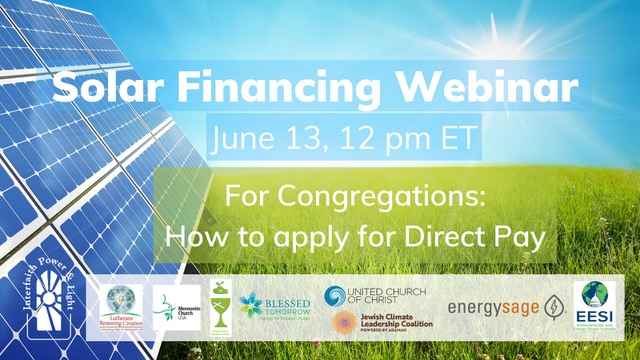
With the passage of historic federal climate legislation offering new funding to reduce the capital cost, many more congregations are considering solar. The webinar will start with the different ways congregations can finance solar, provided by Jerry Bernstein, who has coached many IPL congregations in going solar. Miguel Yanez of the Environmental and Energy Study Institute will provide latest updates on Direct Pay.
Maggie Chappen, Senior Warden from St Andrew’s Episcopal Church in Lewisburg, Pennsylvania, will share her experience filing for Direct Pay for their solar installation. Energy Sage, an electrification marketplace helping IPL congregations find solar and heat pump installers in many states, will provide information as well.
Summer of Action webinar for Faith-Based Environmental Advocacy
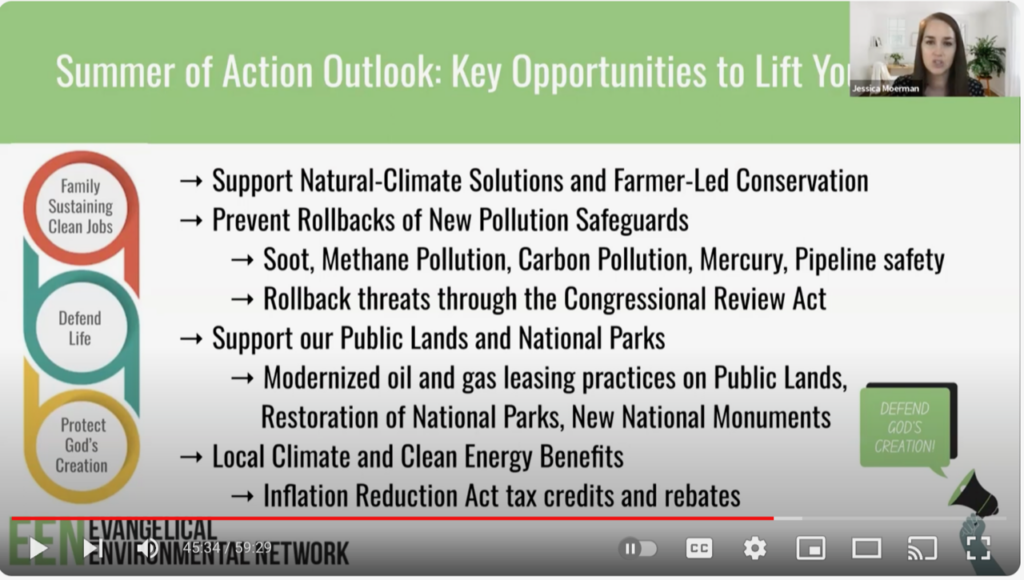
The Evangelical Environmental Network provided an hour-long webinar May 29 including a talk by Samantha Medlock, FEMA’s Assistant Administrator for Resilience Strategy. She introduced tools for climate mapping and planning for resilience and adaptation, as well as information on federal hazard mitigation grants for communities that have suffered a federally declared disaster. The talk includes skills for effective climate conversations and advocacy. Click here to watch the webinar at your convenience.
Update on the Farm Bill
The EEN webinar referenced above includes a quick glimpse of the Farm Bill. This giant legislation is the major source of federal funding for food security, including SNAP (food stamps), but it also has huge impact on land and water conservation and climate resilience. On May 24, the House Agriculture Committee passed its version of the bill to reauthorize the Farm Bill.
The Center for Rural Affairs offers this overview of the current draft of the House bill. “Since farm bill negotiations began, conservation funding—specifically money for working lands conservation programs allocated through the Inflation Reduction Act (IRA)—has been at the forefront of discussion. In a win for the agriculture community, both chambers have agreed that this historic funding should be rescinded from the IRA and built into the farm bill baseline, ensuring the money will grow and be available to producers implementing conservation practices over time.
“The conflict, however, is whether or not to maintain the “climate guardrails” established by the IRA. The House bill removes the stipulation that IRA dollars solely fund climate smart agriculture and forestry practices, such as cover crops, no-till, and prescribed grazing. The Senate Agriculture Committee, on the other hand, is supportive of maintaining these guardrails.”
Nick Bates of the Hunger Network in Ohio will be participating in a national strategy call this week on the negotiations over food policy in the Farm Bill so I will report on that next week, since it’s crucial to food security in Ohio’s communities as well as foreign aid to regions striving to survive hunger crises.
Ohio energy bills still stuck. Help get them moving
The Ohio Legislature held a special session last week, passing two bills which were signed by Governor DeWine, one to extend the deadline so President Biden can appear on Ohio’s ballot in November and the other to ban foreign contributions to ballot issue campaigns like this year’s quest to stop partisan gerrymandering by qualifying the Citizens Not Politicians amendment for the ballot. This Dayton Daily News story explores the complex issues behind this new law, how it is to be enforced (by the Ohio Attorney General, not the Ohio Elections Commission), and likely legal challenges it will face. Meanwhile, the two energy bills we’ve been following did not advance.
Here is a repeat of last week’s information about HB 79 (energy efficiency) and HB 197 (community solar) and how to contact the legislators that are currently deciding on whether they will survive and pass.
The bipartisan HB 79, co-sponsored by Reps. Bill Seitz and Rose Bride Sweeney, would restore energy efficiency programs killed by HB 6 in 2019, replacing the previous programs with voluntary participation by utilities, to help consumers pay for retrofits to reduce their energy needs and save money. HB 79 did not appear on the House agenda for May 22 because enough House members still oppose energy efficiency to block the bill despite Seitz’s power as Minority Leader. Please call your Ohio Rep immediately with your views on this bill. Use this link to find your rep by putting your address in the “Who Represents Me” box and then clicking on the Rep’s photo to access the office phone number.
The House Public Utilities Committee held a seventh hearing May 22 on HB 197, which is a Republican bill to create a community solar pilot program that would enable people and businesses unable to install rooftop solar to share in the cost savings of getting part of their electricity from local, renewable generation. They adopted three amendments but did not yet vote the bill out of committee despite strong support by the Republican Chair and sponsors. Here is the link to send an email to every member of the House Public Utilities Committee.
Advocacy updates are compiled by Ariel Miller, a longtime community advocate and member of Ascension & Holy Trinity, Wyoming. Connect with her at arielmillerwriter@gmail.com.
