
Energy justice bills stalled. Keep calling!
Two bills that would reduce energy burden and carbon emissions failed to progress on May 22. For more background on the economic and environmental benefits of this bill, read our May 7 policy update.
The bipartisan HB 79, co-sponsored by Rep. Bill Seitz and Rose Bride Sweeney, would restore energy efficiency programs with voluntary participation by utilities to help consumers pay for retrofits to reduce their energy needs and save money. This did not appear on the House agenda for May 22 because enough House members still oppose energy efficiency to block the bill despite Seitz’s power as Minority Leader. Please call your Ohio Rep immediately with your views on this bill. Use this link to find your rep by putting your address in the “Who Represents Me” box and then clicking on the Rep’s photo to access the office phone number.

The House Public Utilities Committee held a seventh hearing (an extraordinary number!) on HB 197, which is a Republican bill to create a community solar pilot program that would enable people and businesses unable to install rooftop solar to share in the cost savings of getting part of their electricity from local, renewable generation. They adopted three amendments on May 22 but did not yet vote the bill out of committee despite strong support by the Republican Chair and sponsors. Here is the link to send an email to every member of the House Public Utilities Committee.
Episcopalians attend Statehouse advocacy day for gun safety bills as Texas judge blocks federal rule expanding background checks
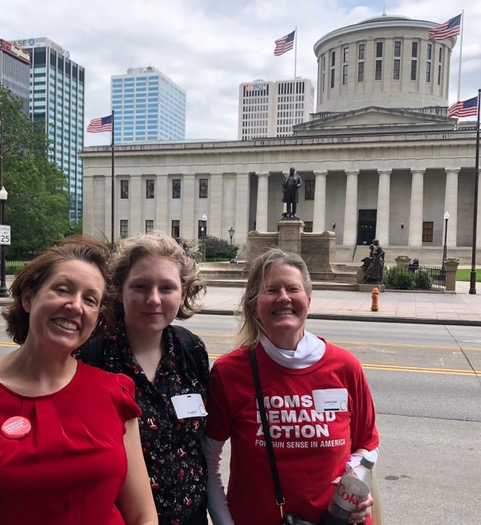
Episcopal clergy and laity from both dioceses joined advocates from across the state to rally at Trinity Church on Capitol Square on May 22 and then meet with legislators to ask for hearings on five bills introduced earlier this year to reduce gun violence through safety measures supported by the vast majority of Ohioans. These include restoring a training requirement for concealed carry of firearms, universal background checks, and safe storage, as well as a red flag law to reduce the risk of domestic violence and suicide. Here’s a summary of the bills.
Just days before, on May 19, Federal Judge Matthew Kacsmaryk in Texas temporarily restrained the new federal rule expanding the gun sellers required to do background checks, which aimed to close the “gun show loophole.” The new rule was adopted under the 2022 Bipartisan Safer Communities Act. Reuters offers an overview of the basis for his ruling in a case whose plaintiffs represent millions of gun owners. A 2023 poll by USA Today and Suffolk University showed that over 90% of Ohioans support mandatory background checks, 88% want to restore a training requirement for concealed carry of firearms, and three fourths support requiring safe storage and a red flag law.
Ohio child care bill would launch three-way sharing of costs
Last week, Senator Michele Reynolds (R-Canal Winchester) and Rep. Mark Johnson (R-Chillicothe) introduced companion bills in late May (SB 273 and HB 610) to tackle two of the worst barriers faced by working parents in Ohio: the huge cost of child care and the state’s unusually ungenerous policy cutting off child care vouchers to any families earning more than 145% of the federal poverty level.
Parents, child care workers, and businesses have been clamoring all year for the state legislature to invest in solutions to the state’s fast-growing child care crisis, where parents who don’t qualify for subsidies can face costs as high as $10,000 a year for the care of a single infant.
Under their plan, employers could voluntarily offer to pay 1/3 of the child care costs of selected employees, the state would pay 1/3, and the employee would pay 1/3. To be eligible, employees would have to be ineligible for public child care vouchers but could earn up to 300% of the federal poverty level. The bill proposes a state appropriation of $10 million, but future funding depends on the legislature, which rejected Gov. DeWine’s proposal last year to modestly raise eligibility for child care vouchers.
“We have recognized at the Ohio Chamber of Commerce that to have a qualified, reliable and thriving base of employees available to Ohio businesses, any discussion of workforce must include affordable housing, transportation and … child care,” said Rick Carfagna, the Chamber’s Senior Vice President for Governmental Affairs, who spoke at the press conference announcing the bills. He described the state’s child care crisis “perhaps the single biggest throttle to employment entry or re-entry at this moment.”
“We know that 800,000 workers in the last year have cut back their hours or retreated entirely from the workforce as a result of barriers to child care,” said Lynne Gutierrez, chief policy officer for the nonprofit Groundwork Ohio.
The Cleveland-based think tank Policy Matters Ohio published an overview of Ohio’s child care crisis in March. “The state makes it more difficult than any other for parents to qualify for Publicly Funded Child Care (PFCC), and reimburses PFCC providers so poorly that the federal government has had to step in to demand policy changes. As a result, too few providers can afford to stay open, and too few families can access affordable child care,” writes Ben Stein in a Policy Matters press release. “By forcing providers to operate with extremely narrow margins, Ohio’s policymakers are driving many out of business,” said Kathryn Poe, co-author of the report. “The ones that survive often can’t afford to retain qualified staff. Ohio’s child care workers are paid $13.15 an hour at the median — too little to make ends meet, and far less than the real value of their work.”
“Ohioans in the child care workforce — disproportionately Black women — have been leaving in large numbers: From 2017 to 2022, the number of child care workers in Ohio dropped by 35.89%,” Ben Stein adds.
I’ll keep you posted on the cost-share bills as they move into hearings. The legislature is considering several other proposals from both parties include a tax credit bill which was introduced last year but has not yet had any hearings.
Advocacy updates are compiled by Ariel Miller, a longtime community advocate and member of Ascension & Holy Trinity, Wyoming. Connect with her at arielmillerwriter@gmail.com.
